
Detroit Regional Chamber > Advocacy > Beyond the Bill: Michigan Rep. Will Snyder (D-Muskegon)

Beyond the Bill: Michigan Rep. Will Snyder (D-Muskegon)

August 14, 2026 Ashley Mathews headshot

Ashley Mathews | Specialist, Public Policy and Business Advocacy, Detroit Regional Chamber

Beyond the Bill is a rotating segment that features a Republican or Democrat Michigan Legislator for Chamber members to get to know on a more personal level and highlight their legislative priorities for Michiganders.

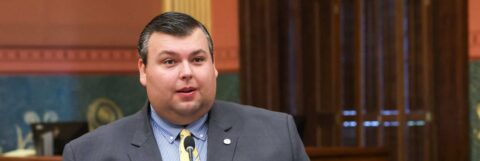
Michigan Rep. Will Snyder (D-Muskegon) is serving his second term for Michigan’s 87th district, which encompasses Norton Shores, Muskegon Heights, Roosevelt Park, Muskegon, North Muskegon, Muskegon Township, Laketon Township, and Dalton Township. Prior to his work as a legislator, Rep. Snyder spent six years working for his predecessor, state Rep. Terry Sabo. He also served on the Board of Directors of Read Muskegon, where he worked to break the generational cycle of illiteracy in Muskegon County.  

Snyder currently serves as Minority Vice Chair on the Appropriations General Government Subcommittee and Michigan State Police Subcommittee, and as a member of the Appropriations Committee, Insurance and Financial Services Subcommittee, and the Select Committee on Protecting Michigan Employees and Small Businesses.  

Expanding Economic Growth Through Opportunity

Snyder’s legislative priorities center on creating a more equitable economic environment for businesses across Michigan. That philosophy is reflected in legislation Snyder is sponsoring alongside Rep. Luke Meerman to support Michigan’s agricultural processing industry. Through House Bills 5168 and 5169, the lawmakers aim to expand Michigan’s food processing capacity by exempting agricultural processing facilities from state sales and use taxes on building materials during major expansion projects. 

“Michigan is home to the nation’s second most diverse agricultural economy,” Snyder said. He believes strengthening processing capacity will help support Michigan farmers while ensuring more agricultural products are processed and retained within the state. 

When asked which policy issue he is most passionate about, Snyder pointed to the state’s current economic development framework, which he believes could better support a broader range of employers rather than concentrating resources on a select few. 

“Michigan’s current business incentive structure rewards a few businesses while leaving many industries and smaller businesses without a fair shot at receiving support,” Snyder said. “As a legislator, it should not be my job to pick winners and losers, but to build a system that targets support for industries that need it while providing a fair opportunity so that everyone can make it in Michigan.” 

Building Michigan’s Talent Pipeline

As Michigan continues to compete for talent and investment, Snyder sees collaboration between industry, education, and government as critical to future success. 

“Michigan was built on the automotive industry,” Snyder said, noting that many of the state’s largest employers continue to be automakers and suppliers. He highlighted the role organizations such as MichAuto play in connecting employers, educational institutions, and policymakers to address workforce challenges. 

Snyder pointed specifically to the High-Tech Talent Initiative as a successful example of collaboration. “While I chaired the budget for LEO, I was able to help MichAuto receive funding for the High-Tech Talent Initiative, which was a strong example of collaboration,” he said. 

He also emphasized the importance of continuing investments in workforce development programs such as Michigan Reconnect and Going PRO. While he views these initiatives as valuable tools, Snyder believes there is room to strengthen outcomes for participants. 

“We need to continue supporting effective programs,” Snyder said, while ensuring workforce initiatives are tailored to individual needs and lead to meaningful career success. He added that stronger wraparound services and success coaching could help participants navigate career transitions and achieve long-term employment goals. 

A Glance Inside Michigan’s 87th District

When asked what challenge facing his district deserves greater statewide attention, Snyder pointed to the ongoing transformation of Muskegon Lake and the broader lakeshore region. 

“For many years, Muskegon Lake was listed as an area of concern by the federal government,” Snyder said. After four decades of restoration efforts, the lake was officially removed from that designation in 2025, marking an important milestone for the community, according to Snyder. He noted that state tools such as Transformational Brownfield Plans have helped attract major investments along the waterfront and believes expanding those programs could help spur redevelopment efforts in communities across Michigan. 

Outside of policy, Snyder highlighted The Deck as one of his favorite destinations in the district. Located on Pere Marquette Beach, he described it as a unique combination of “delicious barbecue and live music” situated on what he calls “the best freshwater beach in the world.” 

When it comes to Michigan-made products, Snyder’s choice reflects another point of regional pride: Pigeon Hill Brewing Company.  

“Beer is so important to Michigan’s economy, culture, and agriculture,” he said. “West Michigan loves its beer, and Pigeon Hill is one of the finest.”