
Detroit Regional Chamber > Advocacy > Chamber Takes Fight for Michigan Employers to Capitol Hill 

Chamber Takes Fight for Michigan Employers to Capitol Hill 

September 17, 2026 Adam Majestic

Adam Majestic | Director, Public Policy and Business Advocacy

During the last week of the congressional session before the November elections, the Detroit Regional Chamber met with members of the Michigan congressional delegation in Washington, D.C., to press for federal legislative action on critical priorities that drive the state and regional economy.  

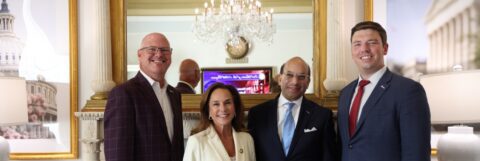
Chamber President and Chief Executive Officer Sandy K. Baruah, joined by Vice President of Public Policy and Business Advocacy Brian J. Shoaf and Director of Public Policy and Business Advocacy Adam Majestic, conferred with lawmakers representing both chambers of Congress. Discussions included meetings with U.S. Rep. Lisa McClain (R-MI-9), Chairwoman of the House Republican Conference, and U.S. Rep. John Moolenaar (R-MI-4), Chairman of the House Select Committee on the Strategic Competition Between the United States and the Chinese Communist Party. 

Mitigating Tariffs, Safeguarding Supply Chains Top List of Policy Issues Discussed

The delegation meetings focused on major challenges confronting employers throughout Southeast Michigan and the entire state: safeguarding domestic supply chains through the Connected Vehicles Security Act, mitigating costly tariffs, preserving seamless cross-border trade with Canada, and protecting federal research investments. 

Engaging directly in the nation’s capital is essential to helping lawmakers grasp the practical realities employers face. 

“Federal policy decisions made in Washington directly dictate the competitive climate for employers back home,” said Shoaf. “In-person fly-ins provide an indispensable bridge between what’s happening in D.C. and back in Detroit, giving business leaders a direct platform to ensure Michigan’s economic priorities remain front and center in congressional negotiations.” 

Continued Advocacy for Federal Research Funding

In addition to supply chain protections and commercial stability across the northern border, the Chamber emphasized the direct link between sustained federal research funding and local job creation. Robust public research allocations serve as the foundation for private industry innovation, enabling advanced manufacturers and technology firms to develop next-generation solutions. 

“Federal research funding is the primary engine behind private-sector innovation,” Majestic said. “When government commits sustained resources to basic research at universities, Michigan businesses can scale those results into applied research and actual, commercial products.” 

Funding has been disrupted over the past two years, leaving many researchers scrambling to make ends meet. The Chamber joined 10 other chambers of commerce from across the country for a roundtable discussion featuring Baruah to examine the impact of federal research dollars on America’s economy. 

“What people miss is that the companies themselves don’t do the research that they used to do during World War II,” said Baruah. “If this country wants to be the innovation leader, we need an avenue to get research developed that will aid our innovation economy.” 

Business for Federal Research Funding was launched in 2025 as a partnership between the Detroit Regional Chamber and the Greater Boston Chamber. It continues to represent the business case for federal research dollars for more than 90 chambers of commerce across 39 states.