
Oct. 16, 2026 | This Week in Government: Gubernatorial Debate Features Back and Forth on Records, Blame for High Costs
October 16, 2026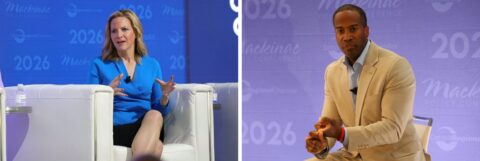
Gubernatorial Debate Features Back and Forth on Records, Blame for High Costs
The second gubernatorial debate was rife with comparisons of each other’s records, blame thrown around at the state’s failing statistics, and policy discussions on how to change the economic success of the state.
Democrat Jocelyn Benson and Republican John James faced off at WDIV-TV’s studio on Thursday to discuss issues that have dominated the campaign cycle: lowering costs, healthcare, and data centers. Much of what Benson and James said was a repeat of their first debate nine days ago.
Affordability kicked off the debate, with James jumping into energy costs as his guiding principle to pushing down prices.
James argued Benson had not held her “climate activist friends” accountable for unaffordability when it came to supporting the 2023 energy legislation in the state, and only started talking about bringing down energy costs once she began her campaign.
This was the first argument where James blamed Benson for state policies in which she did not have control over as secretary of state. Other policy points he claimed were her fault included education and healthcare policy.
Benson later told reporters it seems that James forgot who he is running against.
The two exchanged punches throughout.
“She wants to run against Donald Trump, and she hates him so much that she’s willing for you to pay for it at the pump,” James said during the fuel tax discussion.
“What I hate and what I have no patience for are politicians who are all talk and no action, and that is exactly what my opponent represents,” Benson fired back. “For him to say what he just said when he’s voted six times, six separate occasions, including just a few weeks ago, to continue this war in Iran that is driving up gas prices, tells you everything you know about where he truly stands.”
James also claimed over the course of the debate that Democrats have been in power over the last eight years, while Republicans and Democrats have shared power in the Legislature. Republicans controlled the Legislature from 2019-22, during Gov. Gretchen Whitmer’s first term. Republicans control the House now. Only during the 2023-24 term did Democrats have full control.
“When you’ve had one party in charge of Lansing for eight years, you have to ask yourself why we’re in this position and why we continue voting for people who leave us in this position,” James said.
“Republicans run the state House of Representatives. If my opponent spent more time in Michigan, he would know that,” Benson shot back.
Lowering healthcare premiums, which Benson said James voted to increase in Congress, would be her first steps to pushing down costs. She also restated her plan to invest in clean energy infrastructure in the 2023 energy deal and modernize the grid to bring prices down.
James called her argument “cute,” and defended his record in that he voted to increase transparency in the cost of healthcare.
The candidates also discussed the gasoline tax debate that permeated the last debate.
Fuel prices have been key throughout the race, with both candidates wanting to suspend the federal gas tax. James has called for suspending the state tax, which is tied to the long-term road funding plan, and Benson said she is open to it.
Benson also said James’ record was to blame in voting to support the war in Iran. James repeated that he does not support the war, and has called for it to end, one of the many divisions James has made with the president as the midterms come closer and Trump’s approval rating continues to go down.
“I support suspending the (state) gas tax,” James said. “I would sign it immediately, but she told her running mate not to even take a vote on it. We would have lowered the gas tax for everyone. And right now, gas would be in the threes. It’s in the threes in Indiana. It’s in the threes in Ohio. And you are paying more at the pump, literally, because your pain is her plan. She wants to run against Donald Trump, and she hates him so much that she’s willing for you to pay for it at the pump.”
As Benson has called costs from tariffs “John James taxes,” now James is calling the state gas tax “Jocelyn Benson taxes.” He blamed her running mate, Senate Majority Leader Winnie Brinks, D-Grand Rapids, for not bringing up the bill suspending the state gasoline tax for a vote earlier this month. He said the state could easily take money away from other departments and agencies such as the Michigan Economic Development Corporation to replace the lost funds that go to roads.
Benson again called on James to go back to Congress to take a vote on suspending the federal gas tax, something he said last week he did not have the power to do.
They also tussled over whether James had voted to cut Supplemental Nutrition Assistance Program benefits.
The two also went back and forth as to who has more influence in the surge of data centers. Both have similar platforms on data centers, which include increasing oversight and allowing local governments to decide if they want to allow them.
James claimed Benson put money into her pockets from data center developers with her husband’s involvement in developing and that his company bowled over Saline residents with the OpenAI data center deal. Benson went after James for voting to pass tax breaks to protect development companies and buying stock in data center companies, two allegations James said were untrue.
On the question of education, Benson said three decades of Republican leadership in Lansing has defunded the schools in Lansing. However, K-12 education funding has continued to climb overall. James argued that spending in the state has gone up while performance has done down, calling it “woefully inefficient.”
“What state is she talking about? Spending in the state of Michigan has gone up for our schools, and our performance has gone down,” James said, echoing something Whitmer said in her State of the State address earlier this year.
After the debate, Benson said Republican leaders have continued to defund public schools and that putting more money in the pot is not the end of the investment needs, instead needing to remodel its funding model to replace it with a weighted model to meet “the unique needs efficiently and transparently of each particular school district.”
“My plan would also restore a lot of the funding that was cut over decades of disinvestment, but also ensure that we’re spending it in a more efficient and accountable way, so that we can actually track those results and see our educational outcomes improve,” Benson said.
Data from the House Fiscal Agency and Senate Fiscal Agency shows that the basic per pupil grant has more than doubled since voters adopted the current school funding system, Proposal A of 1994, as has total funds in the School Aid Fund during that time.
James said Benson’s plan would raise taxes, and the state just needs to spend its money more wisely to fund education.
Benson retorted that his plan sounds like it would be run by the DeVos family.
“My opponent has taken close to $10 million from the DeVos family. What’s their claim to fame? Paying politicians to promote private education and defund public schools,” Benson said.
The DeVoses are leading supporters of school choice, principally through charter schools, which are public schools. However, they did back a constitutional amendment in 2000, which voters rejected, that would have created a voucher system providing public funds for nonpublic schools.
Both candidates also explored specific tax plans for property, individual income, and corporate tax structures.
Benson said before she created a plan, there would have to be a wholesale review of revenue in the state to find a plan to reform the structure, something she has continuously said when asked for a specific plan. However, she said whatever the review’s outcome, she would not increase costs for middle class families. She said the plan would have to be weighted and equitable, not a one-size-fits-all model.
Benson has proposed tax breaks for new homeowners and long-term care workers, while James has called for cutting income tax and working to phase out the property tax.
On corporate income tax, Benson said “the current tax code is riddled with loopholes for the wealthy and well-connected,” wanting to close those, while also criticizing James for taking corporate PAC money.
They carried over the debate on personal wealth and being “bought off” by corporate interests from last week’s Senate debate. James claimed that Benson had been bought by billionaires before taking office and receiving funds from California into her campaign.
For tariffs, Benson again touted her plan to bring a subnational agreement to the table, reassuring that she believes she has the authority to implement carve outs while there is a lot of evidence she cannot.
Her plan was “basically tantamount to smuggling,” James said.
When discussing the MEDC, which both said needs an overhaul, Benson brought up old claims about James’ company that he had taken money from the MEDC and had to give funds back due to not creating the jobs necessary. James pushed back by saying these claims were made while he was still in the military.
The candidates were also asked about Attorney General Dana Nessel suing Blue Cross Blue Shield for antitrust violations. Both candidates said they would go after the company as part of their healthcare cost control plans.
Neither candidate could answer a question about what policies they agree with each other on, even though both of them have similar stances on money out of politics, energy costs, and data center regulation.
Potential for a Con-Con Looms Large With Some Groups Prepping Even as They Urge a No Vote
There are some realities of a Constitutional Convention that are well known if voters approve calling one in 2027: the election of delegates will need to happen quickly, the state will have to pay for it, and 148 elected individuals will convene on Oct. 5, with the ability to propose massive changes to the state’s governing document.
And there will certainly be less indoor smoking in 2027 compared to 1961 when the last convention was called.
Little else is a given if a convention is called, and while organizations, including those that are urging a “no” vote, are prepping for the possibility, it’s unclear how deep and widespread the preparation is.
Wendy Block, executive vice president of business advocacy for the Michigan Chamber of Commerce, which is part of the coalition Protect MI Constitution from Special Interests, said she is optimistic voters will reject Proposal 1.
“However, we also recognize there is an outside chance voters will say yes, and we will be off to the races,” she said.
A spokesperson for Senate Majority Leader Winnie Brinks, D-Grand Rapids, declined comment about the potential for a convention. House Speaker Matt Hall, R-Richland Township, did not return a request for comment.
Several watching and researching the issue expect the Legislature will have to act quickly on the basics, particularly calling the election.
Under the Constitution, the election must occur within six months of the convention being approved by voters. It is expected to be a February primary and a May general if the proposal passes.
Lawmakers will have to decide if they want to include delegates in campaign finance law and how that looks. The filing deadline for a February primary election will come quickly.
There is also a 1958 law that caps the salary for delegates at $7,500 annually with a small mileage payment for one trip to Lansing per month. If lawmakers don’t change that – that would be $88,000 in today’s dollars, adjusted for inflation – it could be a barrier on who will seek the positions.
“I always try to be optimistic for good things and the right things happening,” said Sen. Ed McBroom, R-Vulcan, who supports the convention, on the odds the Legislature will take action during lame duck. “I think the Legislature will recognize the essential need.”
Others are less optimistic. Andrea Bitely, founder of Bitely Communications, said the Legislature in the current climate has been unable to get key things done on deadline.
“I don’t have confidence that Brinks and Hall and [Gov. Gretchen] Whitmer can work this out,” she said. “I don’t think they can.”
Ingham County Clerk Barb Byrum agreed.
“I don’t think the Legislature would step in and create guardrails for this process,” she said.
The 71st Legislature did not pass many pieces of implementation legislation, according to the final status book of the 1961 regular session. Lawmakers passed funding for the convention and called the election of delegates.
There was a bill introduced to create a preparatory committee in 1961, but that did not pass. A documentary outlining the convention says a committee was created using outside grant funds. The committee helped educate delegates about the issues that could come up during the convention.
Eric Lupher, president of the Citizens Research Council of Michigan, which has published a series of research papers about the 1963 Constitution leading up to the Nov. 3 vote, said the state, through the Legislature or the Department of State, could be the facilitator of educating delegates about the Constitution.
“Some of the delegates might be term limited legislators,” he said. “Many, I would suppose, are going to be Joe Six Pack who says, ‘I want to be part of this,’ and they don’t really have that information.”
Who will run?
In 1961, there were 1,100 candidates for the 144 districts. In 2027, there would be partisan primaries and general election contests for 148 delegates to represent the state’s House and Senate districts.
“Job number one really will be for groups to start recruiting people to run as delegates,” Block said. “The filing deadline will need to come fairly quickly after the November 3 election. The timeline will be very short.”
A spokesperson for the Michigan Democratic Party did not specify if party officials are recruiting potential candidates.
“Michigan Democrats are urging voters to vote no on Proposal 1,” Leah Leszczynski said in a statement. “We are preparing for all scenarios, but we urge Michiganders to vote no on Proposal 1 and protect our Constitution from special interests.”
Sen. Jim Runestad, R-White Lake, chair of the Michigan Republican Party, did not return a request for comment.
Lupher said the $7,500 salary cap needs to be changed.
“Nobody is going to do that out of goodness of their heart,” he said. “They are going to do this because they care, but they also want to be compensated for their time.”
Block said the $7,500 salary would make being a delegate possible for only a select group of people.
“You will probably end up with a lot of retirees or people who work in professions where their employer can give them an extended leave of absence with paid leave,” she said.
Bitely said the delegates are likely to be hyperpartisans who are interested in the process.
“Out-of-state money will come into play heavily because the Constitution can be designed in a way that favors one political party or one system of government over the other. They are going to try to spend money on it,” she said. “And they are going to recruit candidates. It is going to be a rough process.”
Lupher said he has given a lot of thought as to who might run for delegate and said there won’t be a lot of time to recruit candidates.
“People are going to have to make up their minds pretty quickly,” he said.
He said term-limited legislators with opinions on top state issues and academics are two main groups he’s considered as likely to run.
“The biggest takeaway is people with the time to do this,” he said.
McBroom, a term-limited legislator who is considering a run if the proposal passes, said he hasn’t seen much evidence of organizations recruiting potential candidates.
“I am fascinated by the process and the opportunity to fix a lot of issues,” he said. “And I’d be very interested in serving.”
What will delegates consider?
In 1961, delegates debated key functions of state government and made decisions on redistricting, how to elect the Supreme Court justices, how to appeal a licensing denial and more.
If the proposal did pass, and delegates approved a Constitution, it would need to be put before voters at least 90 days after that vote.
McBroom said the Legislature has the ability to pass resolutions calling on the convention to consider certain issues, like immediate effect, which has caused a lot of controversy in the Legislature.
He also argues the current Constitution is full of problems that could be addressed. He mentioned property taxes and the Headlee Amendment; education policy and the setup of the State Board of Education and the superintendent; the age judges are termed out; and the issue this year with what happens to bills that pass both chambers of the Legislature but aren’t sent to the governor.
“The current setup is a recipe for instability,” he said.
The 1961-62 convention delegates created more than a dozen committees on topics like the judiciary, local government, elections, the Legislature and more. It met for about 10 months before approving a proposed Constitution to put before voters.
Block said if the proposal passes, the Michigan Chamber will communicate with members about the Constitution.
“We will be thinking about talking to our members about the current Constitution and what they like about it and the list of the priority items,” she said.
Bitely said the anger voters feel could lead to Proposal 1 passing, but she doesn’t think the current environment will lead to a good Constitution.
“I am a good-government person at heart and I don’t see how a Con-Con will create a better government in our current environment,” she said.
Still, she said there are going to be top staff from offices and campaigns who are looking for a place to land. They could end up staffing the convention, something delegates have control over.
“We need a true statesman figure to be able to run this convention in a way that is allowing all parties,” she said. “I mean that at this point, Ds, Rs, DSA folks, the MAGA folks, everyone who is elected is going to own a faction.”
Odds of passing
Organizations in Lansing spanning the political spectrum are urging voters to reject a Constitutional Convention, arguing the instability will be bad news for the state.
Byrum, who is a Democrat and Ingham County clerk, said the right to vote by mail and reproductive freedom are at risk if the proposal passes. Voters placed both items into the Constitution via ballot proposals in 2022.
“The passage of Con-Con is very concerning in that voters have stepped up to the plate to enshrine protections in our Constitution that the Legislature refused to do time and time again,” she said.
Bitely, though, said voters are angry and she thinks that will lead to the passage of Proposal 1.
“Everything just feels bad. And everybody is looking for, ‘What can I do to change this?’” she said. “Honestly, the same people that picked [President Donald Trump] are mad and the people who didn’t pick Trump are mad. And why not adjust the Constitution? Maybe it will make things better.”
McBroom, as a supporter of calling a convention, sees it differently. He is optimistic the proposal will pass.
“I am optimistic that voters all over the state can recognize that the State of Michigan has been in decline for decades under this Constitution,” he said.
Block, though, said even though voters are frustrated with dysfunction in politics, she hopes they hear the message that a Con-Con only adds to the risks.
“There are groups ranging from the far left to the far right that come together in agreement that a Con-Con is risky and dangerous,” she said. “We really need to find ways to move together as a state.”
One thing all sides agree on is if voters approve calling a convention, the campaigning won’t stop.
“We are basically going to be running a whole election cycle almost immediately,” Bitely said.
Byrum said the state will be flooded with campaign materials.
“If people are overwhelmed now,” she said, “they haven’t seen anything yet if Con-Con does pass.”
Lansing Clerk Details Safeguards for ‘Safe, Secure, and Accurate’ Elections
Chris Swope, who’s served as Lansing’s city clerk for nearly 21 years, now finds himself “in the middle of one of the hottest congressional districts in the country and one of the hottest Senate seats,” he said Tuesday.
He wants Michiganders to know that he’s confident about the integrity of the upcoming election in Lansing and elsewhere about the state.
“I have faith and confidence that not only my office, but clerks across the state are running safe, secure and accurate elections,” Swope told reporters Tuesday on a press call organized by In Michigan We Trust, a nonpartisan election education campaign.
Swope described protections in place to ensure the security and accuracy of elections ahead of next month’s midterms.
His office sits in the closely watched 7th U.S. House District, where incumbent Rep. Tom Barrett, R-Charlotte, is hoping to fend off Democratic challenger William Lawrence. The statewide race for the open U.S. Senate seat pitting Republican Mike Rogers against Democrat Abdul El-Sayed is also drawing intense national scrutiny.
One protection, Swope said, is the “sheer number of different municipalities that are involved in our elections.” In Michigan, elections are primarily run at the city and township level, but the county is also involved. “There’s a separation of duties that provides additional security,” Swope said.
Michigan requires “logic and accuracy tests” for ballot tabulators and the state has more than 1,600 clerks and “thousands upon thousands” of election workers in polling places on Election Day, Swope said. Certain duties must be performed by a Democrat and a Republican, including handling, sealing and transporting ballots. “No one is left alone with ballots,” he said.
After the election, a bipartisan board of county canvassers will review and certify the results, he said. For state-level offices, the bipartisan Board of State Canvassers will review the work of the county boards to certify those results. Election officials also audit the results afterwards, Swope said.
The bipartisan process involves multiple people “and lots of eyes and lots of opportunity for the public to see things,” Swope said.
After the Trump administration sent federal election monitors to Lansing and other Michigan cities during the August primary election, Swope said Tuesday that his office is prepared if that happens again.
“We had a meeting beforehand” with the monitors in August “to make sure that we were on the same page in terms of the rules of engagement,” Swope said. “I’m confident that we will, if we have them again, it will be a similar circumstance. And if they do violate Michigan election law, I’ve already been in communication with law enforcement about how to handle that, as well as my attorney.”
Whitmer Announces New Space ‘Hub’ in Detroit
Michigan is launching a new “space innovation hub” based in Detroit later this month, Gov. Gretchen Whitmer announced Thursday.
The new endeavor, a statewide network aimed at boosting Michigan’s space technology economy, will be anchored at Newlab Detroit in Corktown’s Michigan Central Innovation District, Whitmer said. It’s funded by a $1.2 million one-year grant from the Michigan Economic Development Corporation and is slated to officially launch on Oct. 28.
“The Space Innovation Hub brings together industry, innovators, and our world-class manufacturing base to ensure Michigan is at the forefront of the next generation of space technologies and creating the jobs of tomorrow,” Whitmer said in a statement.
The hub’s partners include the Michigan Manufacturing Technology Center and the National Advanced Mobility Consortium. Kevin Cronin, Michigan Central’s new executive director of aerospace, will manage the hub, Whitmer’s office said, and the team will include senior advisors with experience at SpaceX, Raytheon, NASA affiliates, the federal Department of Defense and elsewhere.
Top priorities for the hub will include a “sprint to supply space” initiative aimed at expanding Michigan’s manufacturing capacity, year-round industry events, and an annual Michigan space summit, the governor said.
Michigan is home to more than 900 companies that work on aerospace and employ about 30,000 workers, according to the Aerospace Industry Association of Michigan.
“Michigan companies are already contributing to major space programs today, and there is tremendous potential to build on that foundation,” said Aaron Johnson, president of the industry association. “The Space Innovation Hub is an exciting opportunity to bring these strengths together and accelerate Michigan’s role in the growing space economy.”
Michigan’s early involvement on space innovation dates back to work that enabled early crewed space flight, Whitmer’s office said. All three crew members of the Apollo 15 lunar mission were alumni of the University of Michigan.
Analysis: Proposal 2 Changes Leave Some Unknowns if Enacted
The full implications of the proposed changes under a ballot measure that would ban public utilities and corporations with large state contracts from being able to contribute to political campaigns are not yet known.
That was the conclusion of the Mackinac Center for Public Policy in an analysis it published this week on Proposal 2026-2, put forward by Michiganders for Money Out of Politics.
“The full effects of Proposal 2’s proposed amendments to the Michigan Campaign Finance Act are difficult to know. Some of the changes would be implemented based on the secretary of state’s own interpretation of the law,” the analysis states. “Existing judicial rulings may influence how these amendments would work as well. Still other elements of the proposal may be challenged legally, which could result in courts deciding what impact Proposal 2 ultimately has.”
Proposal 2 would prohibit utilities and contractors with over $250,000 yearly in government contracts, and people with organizations with connections to those contractors, from making direct or indirect campaign contributions.
Protect MI Free Speech, a coalition of business groups, is opposing the measure. Opponents have argued it would prevent more people from being able to donate to campaigns than what proponents have stated, adding it would silence the voices of rank-and-file employees, among others tied to corporations or contractors.
The constitutionality of the measure as well as potential First Amendment effects have also been raised by opponents.
Under the measure, internet communications would be added to campaign finance law under disclosure requirements. Another change to the Michigan Campaign Finance Act would enact spending and donor disclosure requirements for some issue ads not currently treated like campaign ads.
The Mackinac Center noted that a new term, “electioneering communication,” that would be created under Proposal 2 is defined as a public message that occurs within 100 days of general elections or within 30 days of primary or special elections.
If the proposal were currently in effect, it would cover all election communications since July 26 ahead of the general election.
“This broad definition seems to include many types of messages and communications that would not be considered political activity under the current law,” the analysis states.
It could be interpreted to include media coverage mentioning local candidates, voter guides that outline candidates, trade association publications mentioning a candidate’s position on an issue and social media posts highlighting a candidate.
Current state campaign finance law only regulates communications that advocate voting for or against a candidate, which Proposal 2 would expand to include messaging that does not do so.
“This would be a significant expansion of the statute’s scope,” the analysis states.
The Mackinac Center also focused on the reporting mandates that would be instituted under Proposal 2.
It states that anyone who makes electioneering communications aggregating $5,000 or more in a calendar year would have to file a report with the state, which would have to be filed within 10 days of reaching the $5,000 threshold. The 10-day deadline would be in place for each $5,000 in aggregated communications beyond the threshold.
“It is not clear from a plain reading what spending would count toward the $5,000 threshold,” the analysis states.
The analysis includes an example of a group printing and mailing copies of a publication listing election candidates.
“Would the $5,000 threshold include what was spent on employee compensation and other costs used to produce the voters guide? Or would it only include the costs the organization spent on promoting and distributing the publication?” the analysis states.
The Mackinac Center also pointed to the disclosure requirements for such reports, including spending records of electioneering communications, names and addresses of who received the spending, information on each individual who contributes more than $100 to pay for the communications and any other information the secretary of state deems necessary.
“The proposal does not provide further details about these requirements,” the analysis states. “It is not clear how organizations would track the people who may have contributed to them to make an electioneering communication.”
It was noted that, if passed, the secretary of state would likely have to address these types of questions as well as develop the report that organizations would be required to submit.