
Sept. 4, 2026 | This Week in Government: As the Conversation Around Higher Ed Shifts, a SE Michigan Community College Initiative Records First Wins
September 4, 2026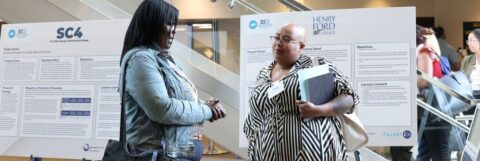
As the Conversation Around Higher Ed Shifts, a SE Michigan Community College Initiative Records First Wins
Within a higher education landscape Americans of many ages feel priced out of and a Michigan economy business leaders say is flailing for talent, a program backed by the Detroit Regional Chamber, its nonprofit partners, and southeast Michigan’s community colleges is documenting success at the end of its first phase in operation.
The regional initiative Detroit Drives Degrees Community College Collaborative, or D3C3, is part of the Chamber’s larger push to address the factors that contribute to “Michigan’s house on fire,” as many Mackinac Policy Conference speakers termed the state of the state’s business ecosystem, workforce, and future economic outlook in May.
The program was launched with initial support from the Ralph C. Wilson Jr. Foundation, Ballmer Group, and Rocket Community Fund and operates across eight community colleges in southeast Michigan, assisted by the Michigan College Access Network and Michigan Community College Association. Its goal: strengthen the colleges so they graduate more students who will contribute to an overall higher share of Michigan residents who hold postsecondary degrees or credentials.
Programs like D3C3, DRC Chief Education and Talent Officer Greg Handel said in an interview with Gongwer News Service, offer a more realistic perspective on the ballooning cost of higher education and the difficulties many new graduates experience in the workforce in 2026 – where many policymakers and pundits have begun to question the value of a degree, Handel said the data shows the credentials students obtain at schools like Schoolcraft College or Washtenaw Community College have never been so worthwhile.
“Back in 2000, you could be relatively prosperous without necessarily having a large percentage of your population with some kind of postsecondary credential,” Handel said. “There were a lot of good-paying, low-skill jobs in Michigan. That is a world that does not exist anymore.”
Michigan sits solidly in the bottom quarter of U.S. states in per capita income, having ranked 40th in the country in 2025, and ranks 33rd nationally in post-high school educational attainment. The latter metric, Handel said, directly informs the former.
“As an entity, the Chamber, which cares about economic prosperity, the primary driver of that income per capita is the number of people with a college degree,” he said, “because in a knowledge economy, you know the companies with the best job go to where the talent is, and they grow where talent is.”
The end goal of the D3C3 program is to have a regional system of community colleges serving students, both directly out of high school and returning to education later in life, who complete their degree programs and are connected to local employers whose career opportunities are well-suited to their skillset and will be served by the students’ education.
Among the phase one directives to meet that goal were strengthening the colleges’ relationships with local high schools and promoting the option for high schoolers to dual-enroll at community colleges while still in grade school.
Handel said the program’s backers saw a major win this year when, after several years of advocating from community college advocates and work with stakeholders at the Department of Lifelong Education, Advancement, and Potential, the Legislature passed the 2026-27 budget with $40 million in state support for dual enrollment costs, which have traditionally been shouldered by K-12 districts and served as a barrier to participation in many parts of the state.
“There’s a recognition that what really held schools back in expanding dual enrollment is our funding formula that basically requires the K-12 districts to fully fund the tuition for it. Until you change that, and the state does what other states do, which is create a separate pot of funding for that, there’s really going to be a limit on growth,” he said. “After a couple of years of pulling together a coalition that included the Chamber, the community colleges, the state itself, this year’s budget includes $40 million to supplement dual enrollment costs. So, we’re hoping to start to see growth as a result of that.”
Among the growth participating colleges have begun to see since emphasizing dual enrollment through the initiative are statistics like Schoolcraft College more than doubling its dual enrollment participation, a 103% increase, while also expanding participation among historically underserved students from 189 to 395 learners; Washtenaw Community College expanding its program to represent approximately 10% of total enrollment and helped connect high school students to mobility-focused, short-term certificate pathways; and Monroe County Community College automating its admissions pipeline to allow local high school graduates to be auto-admitted and reduce the barriers of manual entry.
Another area targeted in the first phase was retention: Macomb Community College expanded to employ seven full-time success coaches working with more than 6,000 high-need students, which D3C3 said helped raise average GPAs from 2.6 to 3.16 and reduced the zero-credit failure rate from 17.9% to 7.5%. Monroe County Community College began using proactive caseload advising and structured orientations to guide first-year students through key milestones, increasing first-to-second-semester persistence to 80%.
The first phase of the D3C3 program ended in July, and the second phase is accepting applications for grant funds. In Phase 2, Handel said colleges will work with the Chamber and its members to better understand how course offerings and degree tracks can match the modern workforce and meet the needs of Michigan’s employers, an area the Chamber has already begun performing field surveys on.
“We’ve done that research. We are right now in the process of updating the research to kind of compare that to what the course offerings are that the community colleges have, how do we kind of validate what the data tells us with employer input?” Handel said. “You can look at the data, but there’s always nuance behind the data, and that’s what the chamber is in the process of doing and will do as part of this next round of funding, is really kind of bring employer voice to say we’ve identified these pathways, now, what can the employers kind of provide us, kind of on an industry-by-industry basis, company-by-company basis, to kind of give us the color commentary behind what the data’s saying?”
Working with community colleges to make progress towards goals like 60% of metro Detroiters holding a postsecondary degree or credential by the year 2030 made sense for the Chamber and its philanthropic partners, Handel said, because the community college model and the recent changes to make it more affordable made it possible to tailor their efforts to target completion of a degree program.
“Nationally, community colleges have always been really good at providing access, but nationally, they struggle with completion rates, and we’re no exception here in Southeast Michigan. There’s a lot of opportunities to help students that might not be headed to a four-year institution, but who see community college as accessible, and we’ve made it much more affordable now for students,” he said. “There was a desire to ensure that more students had access to this first rung, and that they not only had access, but that we were putting in supports to help them complete as well. So (there was) a lot of room to improve completion rates and we had funders really willing to commit substantial resources to improving those, and the funders were really investing in systems change.”
Handel said he hopes the work done in the Detroit area and southeast Michigan during D3C3 will help dispel the burgeoning narrative that it no longer pays to go to school after high school – Gen. Z is struggling, he said, and college affordability is a legitimate concern, but consumer sentiment shouldn’t be treated the same as statistical outcomes.
“A lot of these narratives and the articles that come out, they don’t cite hard data on employment. What they do is cite surveys of how people feel about the value of a degree, and then they always offer examples of students who recently graduated and are maybe having a tough time finding that first job,” he said. “What people kind of fail to take into account is an investment in a college degree; the payback isn’t in the first and second year. The cost of higher education is a concern. It’s something we have to focus on, but I think it’s also equally important to note that there are affordable options available to people. But we need people to be informed consumers of higher education.”
Analysis: Michigan Paying Most Nationally Per Household From Trump Administration Tariffs
A recently released study says Michigan is paying the highest cost per household nationally for the tariffs instituted by President Donald Trump’s administration since his return to office and the third-most nationally in overall estimated total money.
The National Taxpayers Union Foundation, a Washington, D.C. nonprofit group that focuses on tax and governing spending policy, released a study showing that the cost of tariffs to the state of Michigan from January 2025 through Aug. 4, 2026, is about $23 billion.
This averages out to about $5,619 per Michigan household, the highest of any state, with the largest hit coming from products related to the automobile industry and auto parts sector.
At $23 billion in estimated costs due to tariffs, Michigan ranked third nationally in highest overall cost, behind California and Texas.
The report said Michigan is being hit particularly hard given its large manufacturing sector, with about 64% of the overall impact coming from products related to the manufacturing sector.
The Michigan Smart Trade Alliance, in a Thursday release highlighting the study, said the per-household metric is an estimate given that tariffs are paid by importers, not individual consumers.
“The inconsistency of our current trade policies and escalating trade war between Washington and Ottawa is making life much more expensive for families across Michigan,” Mark Fisk, a spokesperson for the Michigan Smart Trade Alliance, said in a statement. “The recent analysis by the National Taxpayers Union Foundation showing Michigan households are absorbing an additional $5,600 in added costs should be a wake-up call for elected leaders in Congress.”
In the study, it was estimated that about $10 billion of the cost of tariffs in Michigan was from trade involving cars and trucks, with another $5 billion coming from auto parts.
Another $1.5 billion was estimated to have come from steel, aluminum and other metals, and $681 million from machinery and parts trade.
“The cost of tariffs is having a chilling effect on Michigan families. The new numbers make it clearer than ever our elected leaders should speak out on behalf of their constituents to eliminate these tariffs and bring down costs,” John Sellek, another Michigan Smart Trade Alliance spokesperson, said in a statement. “Ultimately, families and our entire economy need the same things: predictable prices and the ability to plan for the future.”
States surrounding Michigan were also being hit by multibillion-dollar effects from the tariffs, the report showed.
Illinois had the next highest cost, at $17 billion, or $3,325 per household. This was followed by $11 billion in Ohio ($2,274 per household), $8.4 billion in Indiana ($3,042 per household), and $5.5 billion in Wisconsin ($2,179 per household).
The report states that its figures are estimates based on tariffs paid on imports into Michigan, which is split between statutory tariffs and the executive tariffs enacted by the president.
U.S., Michigan Supreme Courts: There Will be no Voting on ‘Citizen Voting’
A constitutional amendment that would require proof of citizenship to vote is dead for 2026 following Thursday’s denials by both the Michigan Supreme Court and the U.S. Supreme Court of supporters’ requests to put the proposal on the November ballot.
Americans for Citizen Voting – Michigan went to both the U.S. Supreme Court and the Michigan Supreme Court seeking either to compel the Board of State Canvassers to certify its proposal for the ballot. The federal high court denied emergency relief Thursday afternoon.
Thursday evening, the Michigan Supreme Court, in an unsigned order, denied relief, ruling 6-1 the boards’ actions in this case were discretionary, so mandamus relief could not be issued. Justice Brian Zahra, the only justice nominated by the Michigan Republican Party, dissented.
The Michigan Supreme Court also denied relief in a separate case to keep the Michiganders for Money out of Politics proposal off the ballot. There will be two ballot proposals: whether to call a constitutional convention is Proposal 2026-1 and the money out of politics measure, which would block certain political spending from the state’s utilities and state contractors, will be Proposals 2026-2.
“We are deeply disappointed in this outcome, particularly because of the nearly 710,000 Michigan citizens who put their names on this petition believing they would have an opportunity to vote on it,” Kristin Combs, spokesperson for Americans for Citizen Voting-Michigan, said in a statement. “We fought until the very last possible moment because those people deserved to have their voices heard. We are enormously grateful to every signer, volunteer, donor, and supporter who stood with us throughout this
fight.”
After the Michigan Supreme Court’s decision, the Board of State Canvassers canceled its Friday morning meeting, where it was scheduled to consider a 100-word summary of the citizen voting proposal in case it was ordered to appear on the ballot.
Americans for Citizen Voting argued the board should have accepted affidavits from voters whose signatures were rejected by the Bureau of Elections saying they did in fact sign the petition. Several were denied because the group provided them to the board outside of the required deadline. Four were denied because the board determined the signatures on the affidavits did not match signatures in the Qualified Voter File.
Zahra wrote that he would have asked the board to reconsider the four that were determined to not match the QVF.
The Bureau of Elections used a 1,000-signature sample out of the 709,000 submitted to determine whether the group that the 446,000 valid signatures from registered voters needed to qualify for ballot access. The group needed 629 valid signatures in the sample to qualify. The board found they had 626, three short.
“In light of the fact that the board’s determinations are reviewable by this court, I would vacate the board’s decision declining to certify the four signatures with accompanying affidavits that allegedly did not match the signatures in the (QVF). I would remand the matter to the board limited to consideration of whether the four affidavits were in fact valid evidence that the affiants properly signed the petitions in question,” Zahra wrote. “As public servants, the members of the board are sworn to uphold the state Constitution. At a minimum, this court should have remanded to the board to cure the due-process violation by, for example, arranging an in camera review of the (QVF) signatures and providing plaintiffs an opportunity to rebut the comparison, or, alternatively, by accepting the affidavits as legally sufficient in their own right, or, finally, by accepting late submissions of additional affidavits.”
Justice Elizabeth Welch, in a concurring opinion, wrote what Zahra described as relief would violate statute, which requires the Board of State Canvassers to compare petition signatures to the QVF.
“The statute is clear that the Qualified Voter File is the comparator for signatures. Justice Zahra raises important policy concerns about the manner in which signatures are canvassed — concerns similar to those I raised in Drissman,” she wrote. “But again, only the Legislature can fix that process.”
Justice Noah Hood also wrote a concurrence, opining the state’s statutory scheme needs to be amended. He noted the deadlines for ballots to be finalized and for the canvassers to complete its work on petitions essentially overlap.
“As public participation in Michigan’s electoral processes grows, it may exceed the capacity of the statute’s current timelines,” he wrote. “The Legislature should consider revising MCL 168.476 to require earlier deadlines, which would allow more meaningful adversarial proceedings and judicial review.”
Paul Jacob, chair of Americans for Citizen Voting, pointed to Zahra’s dissent, which concluded, “the people of Michigan deserve better.”
“That says it all,” Jacob said. “Michigan voters deserved better from the Board of State Canvassers. They deserved a timely and meaningful hearing from their Supreme Court. They deserved a process driven by the law and the evidence, not partisan considerations. And nearly 710,000 citizens who exercised their constitutional right to petition deserved the opportunity to have their fellow Michiganders vote on this proposal.”
Benson Eyeing Tax ‘Loopholes’ as New Ad Calls for Middle-Class Tax Cut
Democratic gubernatorial candidate Jocelyn Benson launched a new ad over the weekend, discussing special interests and government transparency – and a promise to cut taxes.
The 30-second spot, which will air in markets statewide, is backed by an initial broadcast and cable buy of $52,118, per AdImpact. Benson’s campaign said the ad “draws a straight line” from Benson’s “own middle-class upbringing to the governor she’ll be.”
“I still remember waiting tables and counting tips at the end of my shift. I believe government should work as hard as you do, not for the politicians and corporations driving up costs, but for you,” Benson says in the spot. “That’s why I’ll ban politicians from insider trading and make them disclose their special interest money. Cut taxes for working and middle-class families, not big corporations and take on health insurance and drug companies to lower costs, because Michigan should work for you.”
Asked during a Monday press conference what options she envisioned for lowering taxes if elected, Benson said she would conduct a government-wide review of revenue sources to identify loopholes or redundancies that could enable the state to “return those savings to the citizens.”
“I do believe we need to do a wholesale review of how we’re generating revenue in the state to ensure that it is equitable and sensical. We know there are loopholes in our tax code… like while we all have to pay for our gas in our vehicles, if we have vehicles that require gas, owners of private planes do not need to pay tax on fuel when they fuel those planes in Michigan,” Benson said. “So, what our approach will be is looking at what types of ways can we change and close loopholes that will enable us to generate revenue to the state. What can we do to streamline the expenses of government and the cost of government so that we can return those savings to middle-class families all across Michigan?”
Benson said her campaign will be releasing additional details about its plans for government cost reductions and other affordability initiatives in the coming weeks ahead of the Nov. 3 general election.
Slotkin Talks Banning Chinese Cars, Trade Conflict With Canada
U.S. Sen. Elissa Slotkin is still pushing one of her earliest priorities when taking her seat in the Senate: banning Chinese vehicles from being sold in the United States.
Slotkin, D-Holly, during a roundtable conversation at the Lansing Regional Chamber of Commerce, talked about the importance of a bill reintroduced in July called the Connected Vehicle Security Act, sponsored by her and U.S. Sen. Bernie Moreno of Ohio, which rejects the growing popularity of cheap Chinese vehicles, which she said would be an issue for national security.
Slotkin said the issue has become prevalent with President Donald Trump entertaining the sale of the cars or cutting a deal with the Chinese government, which she fears would lead to American citizens’ personal information being sent to China through the information in the brain of the car.
“There’s no issue that I’ve identified that is more fundamental to our economic security and more fundamental to our national security,” Slotkin said.
For the economic security of the country, and specifically the robust automotive industry in Michigan, she said the state has over 450,000 jobs tied to the industry that could be in jeopardy as a result of investing in the sale of these cars.
However, she did call on American and European companies to make cars with more amenities, like the Chinese companies so they can compete. On the other hand, she said they will never be able to compete with the cost of the Chinese cars, some sliding down to $11,000 because American companies simply don’t have the labor market that China does.
She said Republican colleagues have not shown a lot of bravery in getting this to the finish line but is glad to see at least some bipartisan support.
Slotkin also spoke on the recent tariff conflict between Canada and the United States. The countries have lobbed retaliatory tariffs of $20 billion at each other. She said Trump and Canadian Prime Minister Mark Carney are in a “straight-up manhood fight,” and they are starting to see the “really, really dumb mistakes and fallout” as consequences.
She cited the Gordie Howe International Bridge opening delay as some of the fallout, delayed due to “pettiness.”
Slotkin also referenced Trump’s executive order to name Lake Ontario “Lake America,” a move akin to naming the Gulf of Mexico the “Gulf of America.”
“I’m sorry no Michigander is calling it Lake America,” Slotkin said.
As part of this fight, she said Canada will start to import Chinese vehicles, and they will start to see those cars come through their bridges and tunnels which could “video around Selfridge, around our infrastructure sites anywhere they want, the federal building downtown, whatever they want.”
She also emphasized that there is a lot of shifts in the automotive industry in general, saying the country is “basically walking away from” electric vehicles, which was a major focus of the former President Joe Biden’s administration. She said now other parts of the world, including China, is eating up that market.