- The breadth of Democratic gains distinguished 2026 from a typical midterm shift. Political strategists Jill Alper and Jason Cabel Roe pointed to movement among independents, younger voters, and voters in traditionally Republican areas, although both cautioned against viewing the results as evidence of a permanent political realignment.
- Economic pressures and dissatisfaction with government cut across traditional partisan lines. The discussion highlighted the cost of living, tariffs, corruption, and declining party loyalty as factors contributing to voter movement.
- Michigan’s Democratic sweep creates both opportunities and concerns for the business community. The panel discussed competitiveness, policy stability, Michigan’s declining congressional seniority, and the Chamber’s continued focus on identifying solutions to the state’s economic challenges.
After Tuesday’s Political Tidal Wave, What Comes Next for Michigan Business?
November 6, 2026
Anjelica Miller |
Key Takeaways
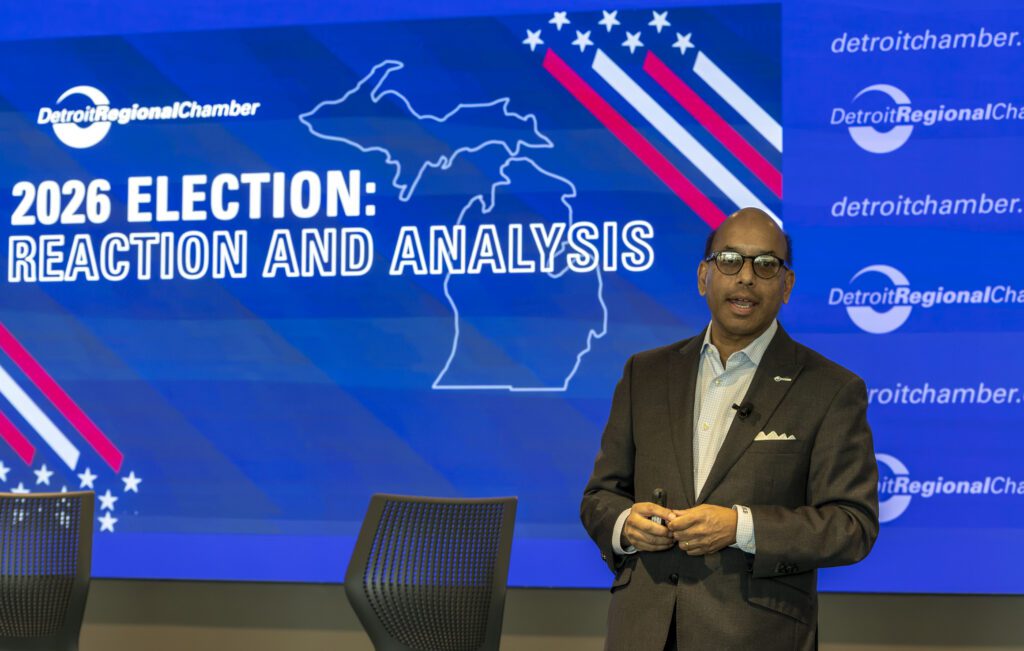
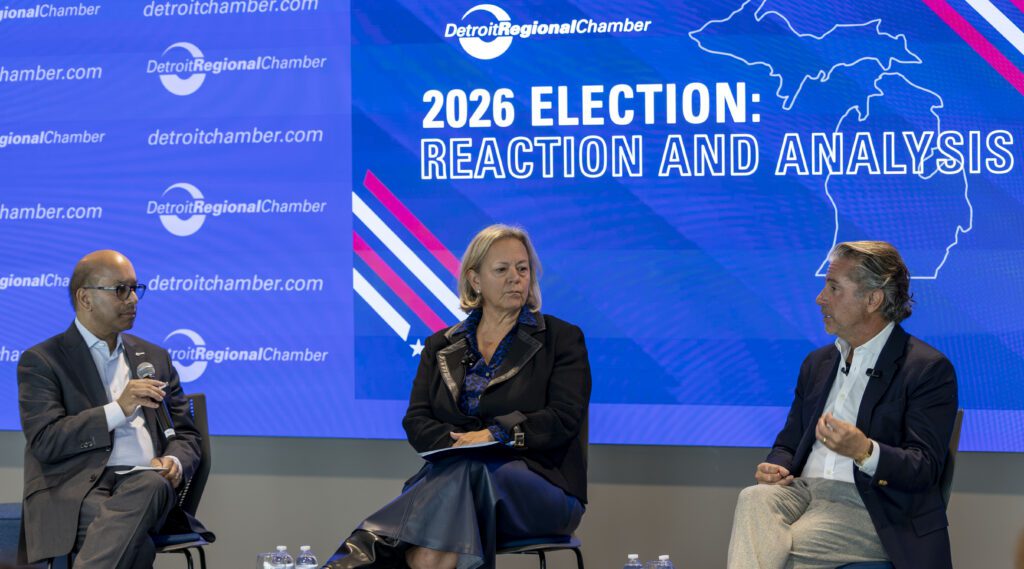
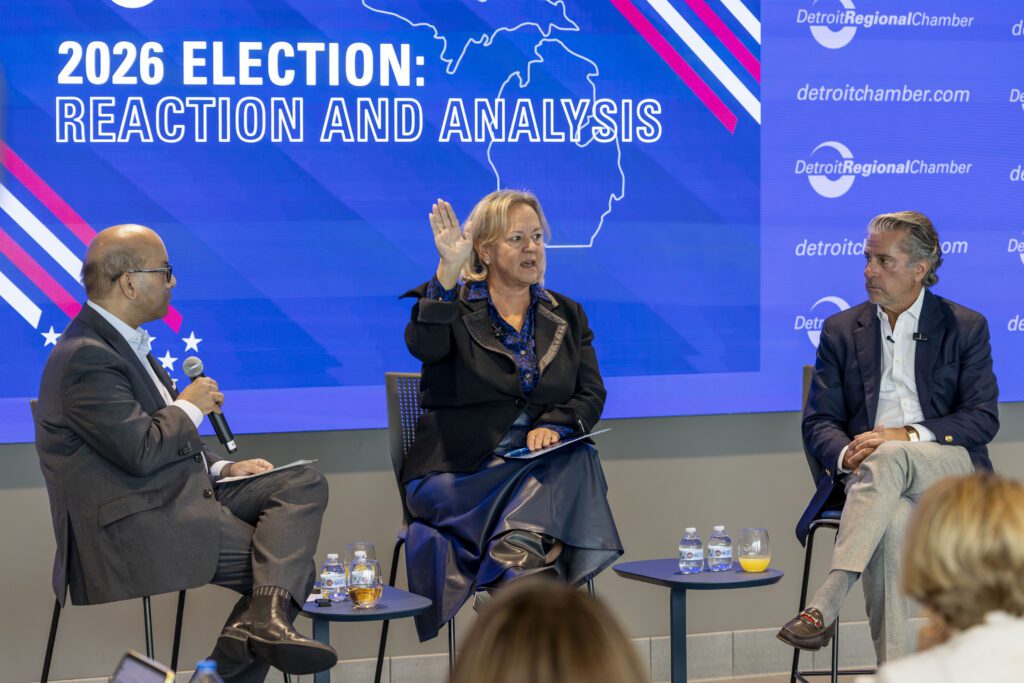
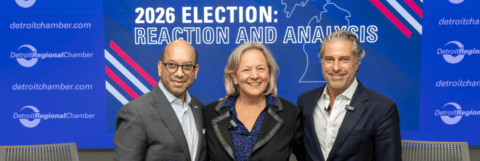
On Nov. 5, political strategists Jill Alper of Alper Strategies + Media and Jason Cabel Roe of Roe Strategic LLC joined Detroit Regional Chamber President and Chief Executive Officer Sandy K. Baruah at the Chamber for 2026 Election: Reaction and Analysis. The conversation examined what made the 2026 election different, the economic and political forces that shaped voter decisions, and how the results could affect Michigan’s political and business landscape.


The Breadth of the Election Results Defied a Typical Midterm Shift
For Alper, the size and geographic reach of Democratic victories distinguished 2026 from previous elections in which voters rejected the party in power.
“It is really cataclysmic,” Alper said, comparing the results with previous midterm elections and the Democratic wave following Watergate. “People are calling it a ‘blunami,’ if you will. So, I think this is something that is going to take the Republican Party maybe a decade to get past, especially in the Senate, right? We look at those seats, I mean, that’s a six-year wait.”
Alper said polling began to show signs of the shift before Election Day, as independents moved toward Democrats and voters in traditionally Republican states showed greater willingness to cross party lines. She also pointed to Democratic candidates in red states who significantly outperformed the 2024 Democratic presidential ticket.
Roe similarly identified the breadth of Republican losses as his biggest surprise.
“I would just say the breadth of it,” Roe said. “And I think a tidal wave is a great way to phrase it because these things start many miles out into the ocean and there’s nothing you can do to break it hitting the shore.”
Despite the scale of the results, neither strategist characterized the election as evidence of a settled Democratic realignment.
“I think it’s an anomaly because I don’t think they were necessarily voting for Democrats,” Roe said. “They were voting against Republicans.”
Economic Pressure and Voter Independence Reshape Political Coalitions
The strategists identified the economy, voter dissatisfaction, and weakening party loyalty as major forces behind the results. Roe said the Republican coalition could continue becoming more racially diverse and working-class, while younger voters remain particularly fluid between parties.
One economic issue Roe said received less attention during campaigning was tariffs, which he said appeared among voters’ top concerns in exit polls. He connected that issue with broader cost-of-living pressures, particularly for younger voters.
“When you put yourself in the shoes of these young people, that things that we might be able to absorb and the cost of living, because it’s negligible to our income, it’s debilitating for them,” Roe said. “They’re affected by the economy more than any other issue.”
The strategists also identified corruption as an important voter concern. Roe said it ranked highly in his polling, while Alper described a broader frustration with whether government and political systems work for ordinary people.
“Corruption isn’t just the kind of corruption that we think sometimes politicians become embroiled in,” Alper said. “It is this deep sense that voters have about the system being rigged against them, the role that money plays in politics.”
Michigan’s New Political Landscape Puts Competitiveness Back at the Center
Turning to Michigan, Alper and Roe discussed what the new political environment could mean for the state’s economic competitiveness, policy stability, and influence in Washington. Alper said elected officials across the political spectrum will face pressure to deliver tangible results.
“There is a conversation unfolding, I think, within both parties from the extreme right or extreme left to the center, but the American people have put both parties on notice that if you don’t get anything done, you’re gone,” she said.
Roe also raised concerns about Michigan’s declining congressional seniority, noting that the state historically benefited from members holding influential committee positions.
“We don’t really have the kind of seniority that we once did,” he said.
Baruah also gave a brief Chamber perspective on the situation, explaining that the Democratic sweep presents both possibilities and concerns for the business community, including questions about economic development and the environment for job creators. At the state level, he connected the results to the Chamber’s broader message about Michigan’s economic challenges.
“We keep pushing; simultaneously, the House is on Fire, but we keep posing the question of, you know, what’s the fix, right?” Baruah said. “We don’t want to be viewed as an organization that’s just howling at the moon, you know, admiring the problem.”
The discussion ultimately returned to policy stability. As Michigan enters a new political era, the panel emphasized that the implications for business will depend on whether elected leaders can translate the election results into policies that address competitiveness, affordability, and long-term economic growth.
“I see this as a moment of opportunity for people to roll up their sleeves and get in there and improve what’s not working,” Alper said.
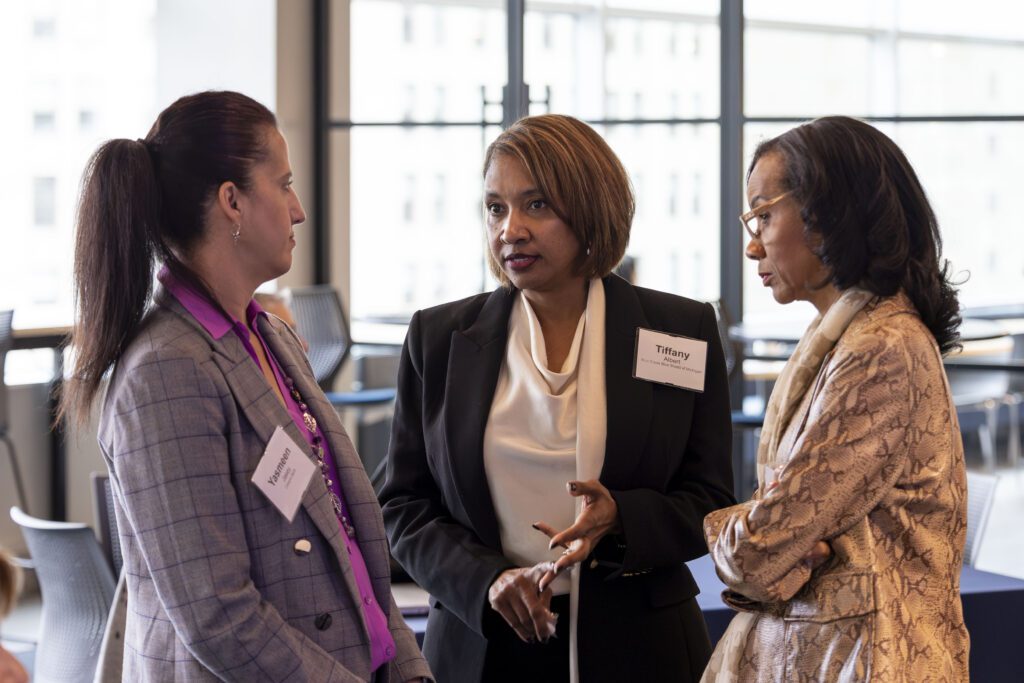
Event Photos