

Detroit Regional Chamber > Advocacy > Beyond the Bill: Rep. Mike McFall (D-Hazel Park)

Beyond the Bill: Rep. Mike McFall (D-Hazel Park)

June 17, 2026 Ashley Mathews headshot

Ashley Mathews | Specialist, Public Policy and Business Advocacy, Detroit Regional Chamber

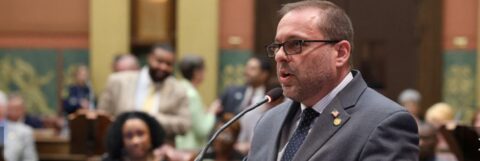
Photo credit: Michigan House of Representatives

Beyond the Bill is a rotating segment that features a Republican or Democrat Michigan Legislator for Chamber members to get to know on a more personal level and highlight their legislative priorities for Michiganders.

Michigan Rep. Mike McFall (D-Hazel Park) is serving his second term, currently representing the 14th House District, which includes parts of Oakland County and Macomb County, including Center Line, Madison Heights, Hazel Park and Warren. He has spent much of his career in the nonprofit sector and worked for the Williams Syndrome Association before being elected. Before being elected to the House, McFall served on Hazel Park’s City Council, where he played an integral part in community building. 

McFall currently serves as the Minority Vice Chair on the Natural Resources and Tourism Committee and is a member of the Government Operations Committee. 

Policy Priorities and District Needs

McFall highlighted his work on the MI Secure Retirement legislation, House Bills 5335-5336, as the legislation he has supported that will have the biggest impact on Michigan’s economy. 

The proposal would expand access to retirement savings by allowing workers to contribute to individual retirement accounts through payroll deduction, even if their employer does not offer a plan. As he noted, a significant portion of Michigan’s workforce currently lacks access to employer-sponsored retirement options, leaving many at risk of financial instability later in life.  

McFall framed the legislation as a pragmatic, bipartisan solution that supports both employees and small businesses. 

“MI Secure Retirement provides a practical, bipartisan path forward to give workers the ability to save for retirement, support small businesses, reduce taxpayer costs, and strengthen Michigan’s long-term economic foundation,” he said. “It would require no employer contributions, no administrative fees, and no fiduciary risk, ensuring that small businesses, which often lack the resources to administer a retirement plan, can provide this benefit at no additional cost.” 

Bipartisan Work on Retirement

McFall highlighted his work on the MI Secure Retirement legislation, House Bills 5335-5336, as the legislation he has supported that will have the biggest impact on Michigan’s economy. 

The proposal would expand access to retirement savings by allowing workers to contribute to individual retirement accounts through payroll deduction, even if their employer does not offer a plan. As he noted, a significant portion of Michigan’s workforce currently lacks access to employer-sponsored retirement options, leaving many at risk of financial instability later in life.  

McFall framed the legislation as a pragmatic, bipartisan solution that supports both employees and small businesses. 

“MI Secure Retirement provides a practical, bipartisan path forward to give workers the ability to save for retirement, support small businesses, reduce taxpayer costs, and strengthen Michigan’s long-term economic foundation,” he said. “It would require no employer contributions, no administrative fees, and no fiduciary risk, ensuring that small businesses, which often lack the resources to administer a retirement plan, can provide this benefit at no additional cost.” 

Michigan’s Talent Pipeline

Looking ahead, McFall emphasized the importance of strengthening connections between education and industry to support Michigan’s automotive and advanced manufacturing sectors. 

When asked what partnerships between industry, education, or government he believes are most needed to strengthen Michigan’s automotive sector, McFall said that “strengthening Michigan’s automotive sector starts with making sure people have real pathways into good-paying jobs.” 

“That means bringing automakers and suppliers together with our community colleges and universities to create clear pipelines into careers in EV technology, advanced manufacturing, and software,” he said. “Attracting and retaining top talent benefits us all.” 

For McFall, the biggest opportunity to strengthen Michigan’s talent pipeline is expanding “hands-on learning, like career tech programs, apprenticeships, and stronger partnerships between schools and local employers so students can build real skills early on,” he explained.  “We can’t ignore the basics like career guidance and mental health support, because students need that foundation to succeed. If we get this right, we’re not just preparing students for the future, we’re helping them build one here in Michigan.”

Beyond Lansing

Outside of policy, McFall’s favorite hidden gem in his district is Loui’s Pizza in Hazel Park, saying that  you “can’t go wrong with one of the Detroit-style pizza originals.”  

Additionally, when asked what his favorite Michigan-made product, McFall said, it “has to be Faygo pop, especially their Rock & Rye. It’s something I grew up with, and it still takes me right back every time I have one. There’s just something about that flavor that feels uniquely Michigan.”