
Detroit Regional Chamber > Advocacy > Detroit Regional Chamber Testifies Against Restrictive Stock Buyback Legislation

Detroit Regional Chamber Testifies Against Restrictive Stock Buyback Legislation

May 22, 2026 Adam Majestic

Adam Majestic | Director, Public Policy and Business Advocacy

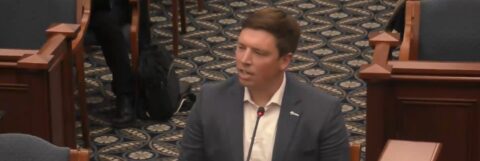
The Detroit Regional Chamber testified before the Senate Economic and Community Development Committee on May 21, strongly opposing Senate Bill 783.

Senate Bill 783 would prohibit publicly traded companies from undertaking stock buybacks while receiving state economic development incentives. Adam Majestic, Public Policy and Business Advocacy Director for the Detroit Regional Chamber, testified that the legislation fundamentally mischaracterizes corporate finance and threatens the state’s economic momentum.

During the hearing, Majestic corrected the narrative that stock buybacks solely enrich corporate executives or Wall Street. When a company engages in a stock buyback, it reduces outstanding shares and increases the value of the remaining shares, strengthening the retirement savings of teachers, first responders, and union workers. Broadly penalizing this practice ultimately hurts families across the state.

Additionally, the bill ignores the national economy and puts Michigan in a separate category for corporations.

“This bill ignores the hypercompetitive reality of the national economic development environment,” Majestic said. “If we force global companies to choose between standard capital allocation strategies or expanding Michigan, they’re going to just take their jobs elsewhere. This bill creates a poison pill for economic development, adding these additional hoops that Michigan already has for development.”

Despite the Chamber’s testimony and strong opposition from the broader business community, the committee voted to report Senate Bill 783 to the Senate floor with a recommendation that the bill pass. The Chamber will continue advocating for tools that attract job providers, maintain a competitive business climate, and ensure long-term prosperity for the region and the state.

View Majestic’s full testimony below, which begins at 55 minutes and 25 seconds.

Rail, Curriculum, Tax Cuts, and Affordable Housing

On May 19, the Chamber opposed SB 958 and 959. SB 958 would require a train to be operated by at least two individuals. SB 959 would require the installation of wayside detectors along railroad tracks. These bills combined would make Michigan rails an outlier on the national scale, causing headaches for operators.

On May 20, the House Education and Workforce Committee voted out HB 5819-5821, which would require schools to adopt a science of reading curriculum. The Chamber supports this package. Additionally, the committee heard testimony on HB 5983-5984, which creates public innovative programs. These programs tailor a student’s education to their unique needs, strengths, and interests. The Chamber will be supporting this package.

Also on Wednesday, almost all the bills in the House property tax cut proposal – HBs 58725879 – were approved 57-46. Rep. Karen Whitsett (D-Detroit) voted with Republicans, and Rep. Jaime Greene (R-Richmond) voted against the bills.

Overall, the bills would cut property tax revenue by more than $5 billion. Although Speaker Hall has said his intent is for the plan to be revenue neutral, a sales tax expansion did not clear the committee or the House on Wednesday.

The package is tied to HB 5880, which would expand the 6% sales tax to unspecified services. Hall has repeatedly said the tax would apply only to “luxury” services. Still, there is no bill language outlining what those services are or exactly how much revenue the tax would generate. Because of the tie bar, nothing the House passed Wednesday can take effect unless the House eventually passes the services tax and Gov. Whitmer signs all the bills.

On May 21, the Chamber supported HBs 5805-5807. This bill package requires the Michigan State Housing Development Authority (MSHDA) and the Department of Treasury to establish a new housing opportunity tax credit program to incentivize the development of qualified low-income housing projects in the state. Additionally, the legislation amends the Income Tax Act and Insurance Code to establish guidelines for how taxpayers, flow-through entities, and insurers can claim these nonrefundable credits against their tax liabilities.