
- Michigan must move beyond policy inconsistency to long-term, coordinated action.
- The Marygrove “cradle-to-career” model demonstrates how partnerships with higher education and philanthropy can improve educational outcomes while strengthening the surrounding community.
- Scaling successful education models statewide is essential to ensure all students, regardless of ZIP code, benefit from high-quality education.
From Cradle to Career: What It Takes to Make Michigan a Top-10 Education State
May 27, 2026
Allie Ciak |
Top Takeaways
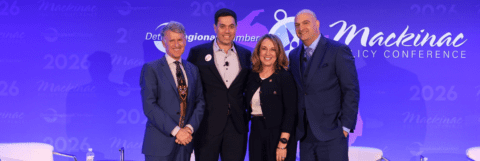
Speakers


Michigan’s education system is at an inflection point, driven by a significant decline in educational outcomes in recent years. Once ranked 16th nationally in fourth-grade reading, Michigan now ranks 44th, mirroring its overall K–12 standing. Framing this moment as an opportunity rather than a worsening inevitability, panelists focused on how to reverse decades of educational decline the state has endured through models like The School at Marygrove in Detroit.
View the full video below.
Breaking the Cycle of Inconsistency
One of the most persistent challenges is the state’s pattern of inconsistency. Michigan’s backslide is not due to a lack of talent or dedication; the state continues to have strong educators, administrators, and organizations. However, as Business Leaders For Michigan’s Jeff Donofrio noted, “the system is not working for our children and our kids really can’t wait for us to get our act together.”
“And in a purple state like Michigan, [policies] can ping-pong back and forth,” he said. “So, we’ve got to bring semblance to governance at the statewide level. We got to bring semblance to the policy and the funding, the resources, and we’ve got to set a goal for what we want this system to actually produce.”
A Proof Point in Detroit: The Marygrove Model
While the challenges are statewide, the Detroit Public School Community District (DPSCD)’s Marygrove campus demonstrates what is possible when systems and goals align. Its “cradle-to-career” approach creates a continuous pathway from pre-K through college, grounded in partnership and intentional design.
At its core is collaboration among DPSCD, the University of Michigan, the Kresge Foundation, and other community partners to reimagine a public education ecosystem and its impact on the community.
As the University of Michigan’s Elizabeth Birr Moje explained, this work reflects a deliberate shift away from traditional, disconnected models of education. Higher education institutions must engage directly with K–12 systems, particularly within vulnerable communities. Rather than operating from a distance, the University of Michigan embedded itself within the Marygrove campus to co-create solutions tailored to the community.
“We need to better educate our teachers so that they can better educate our children,” she said. “ …We are actually studying in real time so that we can make changes that children and teachers deserve, but we’re also studying the impact of the work.”
The Marygrove partnership operates as a “small systems approach,” serving students immediately while acting as a proof point for broader transformation. Its components are interconnected: a project- and place-based curriculum connects classroom learning to real-world applications and career pathways, while a teaching school model prepares educators through hands-on experience and ongoing coaching.
The Power of Partnership and Investment
DPSCD Superintendent Nikolai Vitti emphasized that Marygrove’s success is rooted in partnership and strategic investment in public education, calling it “a moral investment.” Empowering educators and partners to design Marygrove as an educational hub, allows resources to align with community priorities and drive impact.
The decision to build this model within the traditional public school system was deliberate, aimed at strengthening neighborhoods and delivering long-term change. However, the model would not exist without external funding and vision.
“An outside organization like Kresge with the resources, the influence, the political capital to actually invest in traditional public education … [and] provide the funding, the strategy, the partners, a building…” Vitti said. “Investing in a neighborhood school is actually investing in the neighborhood. So, more people move to the neighborhood, more people stay in the neighborhood, and they can see their children going from pre-k all the way to 12th grade in one school.”
Creating Pathways That Inspire Students
At Marygrove, engagement is driven by visible, intentional pathways. From pre-K through high school and into college, students are exposed to careers in architecture, engineering, social justice, and mor, supported by direct connections to university programs and faculty.
This early and sustained exposure helps students envision what is possible and understand the relevance of their education. By embedding these opportunities within a neighborhood school, the model also strengthens the surrounding community, encouraging families to invest in neighborhoods where clear, continuous pathways support academic success and long-term stability.
This session was hosted by The Kresge Foundation.