Detroit Regional Chamber > Mackinac Policy Conference > Showing Strength Amidst Geopolitical Uncertainty

Showing Strength Amidst Geopolitical Uncertainty

May 27, 2026

Top Takeaways

  • Michigan’s future competitiveness depends on advanced manufacturing, AI infrastructure, and targeted industrial policy. 
  • Both speakers warned that China’s aggressive industrial strategy poses a direct challenge to U.S. manufacturing leadership. 
  • State leaders must streamline permitting, reduce business friction, and align workforce, energy, and infrastructure investments around a focused economic strategy. 

Global uncertainty may be rising, but leaders at the 2026 Mackinac Policy Conference argued that Michigan still has a rare opportunity to reclaim industrial leadership — if it moves quickly and strategically. 

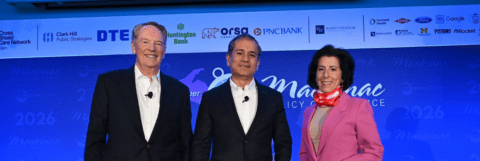
During a wide-ranging discussion on economic competitiveness, McKinsey Senior Partner Shubham Singhal framed the challenge facing business and policy leaders.  

“What really matters is adaptability,” Singhal said, noting the compounding disruptions of COVID-19, geopolitical conflict, and changing global trade dynamics. “The flip side of uncertainty is opportunity.” 

The conversation featured Gina Raimondo, the former U.S. Commerce Secretary and the first female governor of Rhode Island, and Robert Lighthizer, the former U.S. Trade Representative. Both argued that the next decade of economic growth will hinge on manufacturing capacity, AI infrastructure, and industrial policy. 

AI, Manufacturing, and the New Competitive Landscape

Raimondo said that states and nations can no longer rely solely on market forces to remain competitive. Instead, governments must intentionally invest in strategic sectors. 

“You have to have an AI strategy. You must have an AI quantum and biotech strategy,” said Raimondo. “Every business will be an AI business.”  

Raimondo warned that China’s technological ambitions extend well beyond low-cost manufacturing. “We underestimate that to our peril,” she said. “To compete, we need to invest in what we’re good at, bring our allies towards us, secure our supply chains with our allies, and have responsible tariff policies to make sure that China doesn’t eat our lunch.” 

Lighthizer reinforced that argument, saying the U.S. trade system has failed industrial states like Michigan. 

“What you’re doing is you’re competing with other states … now you have to get better than other states, and that means lower taxes, it means lower regulations,” he said.  

Don’t Overlook the “People Strategy”

While Raimondo advocated for technological innovation, she urged the audience not to overlook the human element. 

“If someone asked me, ‘Hey, Gina, what will it take for America to lead in the global AI competition?’ I would say we need a tech strategy to have the best chips, the best models, plentiful energy, et cetera, but we also need a people strategy,” she said. “If the average American gets left behind or feels left behind, and we have the best chips and the best models, we will not lead.” 

Lighthizer pointed to China’s subsidies, trade protections, and coordinated investment strategy as evidence that the U.S. must respond more aggressively. 

“China leads because they have a closed market, they have tariffs, they have the banking system that subsidizes banking,” Lighthizer said. “We’re not going to compete with China unless we step up and have an industrial trade policy.”

Michigan’s Opportunity to Lead

For Michigan, the discussion underscored a central message: the state’s manufacturing heritage remains one of its greatest assets, but maintaining that advantage will require faster execution, coordinated policy, and sustained investment in the industries that will shape the next generation of economic growth. 

Despite the challenges, both leaders closed with an optimistic message for Michigan. 

“This is your state, dig in and make it better,” said Raimondo in her closing remarks. “Make a plan, get a strategy, pull the levers of power. … This has to be driven from the governor on down to the smallest manufacturer.” 

This session was hosted by McKinsey and Co. and editorially crafted in partnership with Crain’s Content Studio.