Detroit Regional Chamber > Education & Talent > Syncing Up for Students

Syncing Up for Students

May 27, 2026 Gillian Ryan headshot

Gillian Ryan | Employer Engagement Specialist, TalentEd, Detroit Regional Chamber

Top Takeaways

  • Michigan’s challenge is system alignment, not lack of effort or ideas. 
  • A cradle-to-career approach is taking shape, yet still out of reach for many students. 
  • Students are asking for more academics—they want real-world experiences and clearer career pathways. 

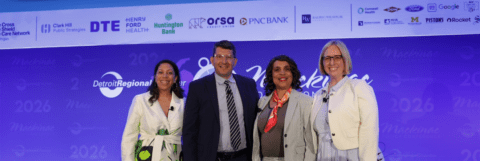
During the 2026 Mackinac Policy Conference, state leaders discussed how to advance the foundation for transformative education change, where alignment and momentum are already taking hold, and where stronger coordination is still needed to turn shared goals into lasting progress. 

View the full video below.

Michigan’s Big Challenge: Systemwide Alignment

While progress is happening across Michigan’s education landscape, the panel emphasized that fragmented systems continue to slow momentum. Collaboration across state government, education agencies, and local districts is improving, but inconsistent execution limits statewide impact. Panelists agreed that real change requires sustained alignment across policy, funding, and implementation, not just isolated wins.  

Glenn Maleyko, State Superintendent of Public Instruction, reinforced this point by emphasizing that meaningful progress depends on collaboration and a shared commitment to putting students first. As he put it, “if you’re going to hire me, it’s going to be collaboration, and it’s going to be students first… we need to work together and get behind it.”   

Building a Pre-K-to-Career Pipeline Requires Greater Coordination

Michigan has expanded access across the state, from universal pre-K to tuition-free community college, but leaders noted that access alone is not enough if students and families struggle to navigate or fully benefit from those opportunities. Creating a true cradle-to-career pipeline requires clearer connections, earlier engagement, and stronger communication across systems.  

Beverly Walker-Griffea, who leads the Michigan Department of Lifelong Education, Advancement, and Potential (MiLEAP), emphasized the shift away from fragmented approaches, saying, “we’re not going to do this in little pieces anymore—we’re building a continuum… from birth all the way to getting a credential.”  

That continuum is designed to better connect early learning, K-12, and postsecondary pathways into a single, coordinated system. Still, the panelists acknowledged that awareness gaps and uneven implementation remain barriers that must be addressed to ensure that all students can succeed. 
Students Needs Earlier Career Exposure and Hands-On Learning at Scale

Students are increasingly asking for more career exposure, real-world experience, and clearer pathways beyond graduation, but current systems are not yet meeting those needs. While opportunities like dual enrollment, internships, and career-connected learning are expanding, they remain inconsistent across regions and schools.  

Senior Literary Advisor Michelle Richard emphasized that the goal must go beyond academic content, noting that education should prepare students to be “creative problem solvers who can solve problems we don’t even know exist yet.” That shift signals a broader push to redesign high school around real-world readiness and stronger connections to careers. 

This session was sponsored by The Skillman Foundation.