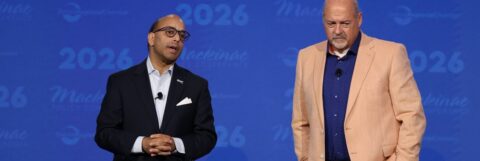
After the Conference Chair announcement, Baruah addressed what he described as an “unscripted but necessary” addition to today’s conversations: the instability surrounding leadership at three of Michigan’s R1 public universities.
Referencing the recent departure of Kevin M. Guskiewicz, who was President of Michigan State University, Baruah said the issue extends beyond any one campus and reflects a deeper structural challenge in how the state governs its flagship research institutions.
“It is unique in the nation and not in a good way,” he said.
Baruah tied the governance issue directly to the Chamber’s broader economic concerns, arguing that leadership churn at major universities affects business partnerships, talent recruitment, and the state’s long-term competitiveness. He noted that employers and institutions make long-term bets on university relationships, and frequent turnover makes those partnerships harder to sustain.
“The most senior R1 university president in Michigan has been in the job for about six months,” he said, underscoring the depth of the instability.
Baruah closed by urging attendees to treat R1 university governance reform as part of the same common ground agenda that shaped the rest of the Conference: the status quo of leadership exiting suddenly and often is not sustainable. If Michigan wants strong universities, strong talent pipelines, and strong business partnerships, it must address the governance structures that continue to undermine institutional stability.