Detroit’s banking and finance sector remains resilient, but is being actively shaped by consolidation, AI, and generational shifts reshaping the workforce. While the industry continues to evolve, opportunity remains strong for those who are adaptable, curious, and open to navigating non-linear career paths.
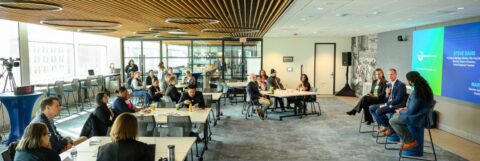
A panel discussion during the Detroit Regional Chamber’s TalentEd Industry Insights series brought together leaders from across Detroit’s banking and finance sector to share real-time insights on workforce trends, talent needs, and the evolving nature of the industry. The conversation, moderated by Rocket Community Fund’s Director of Education and Employment, Marvin Logan, framed a shared goal of keeping talent in Detroit and explored how employers and educators can better align.
Positioning for Growth in a Changing Financial Landscape
Detroit’s banking and finance industry continues to thrive despite significant transformation because of consolidation, technology, and shifting market dynamics. The panel emphasized that while these changes can cause uncertainty, they also open the door to new opportunities. As institutions streamline operations and invest in digital capabilities, the nature of work is evolving but not disappearing.
Steve Davis, Michigan Market President of Fifth Third Bank and Chamber Board Member, reinforced that while parts of the industry are automating, others are growing and if individuals can understand where value is shifting, they will be able to successfully navigate emerging growth areas.
“When there is significant change, there are also significant opportunities… if you’re on the customer-facing side… that’s a great time,” he said. “We’re hiring, we’re always looking for people.”
Building Adaptable Talent Pipelines for the Future Workforce
A theme across the panel is that traditional, linear career pathways are no longer the standard in banking and finance. Instead, success is increasingly defined by an individual’s ability to adapt, explore, and pivot across roles and functions. Rather than following a single track, professionals are encouraged to build through lateral experiences that strengthen their understanding of the business.
Yasmeen Jasey, Michigan Regional President of Citizens and Chamber Board Member noted, “there is no single path… you can take multiple different paths to get from one end of the world to the other,” and emphasized the importance of resilience when navigating challenges, adding that when obstacles arise, individuals must be willing to “dust yourself off, get up, and jump on another path.”
Long-term success depends on curiosity and continuous learning across an organization. Individuals should be prepared for not only their own role, but for a career journey that will evolve and reinvent itself over time.
The Value of Human Skills in an AI-Driven Economy
As AI continues to reshape technical work across industries, panelists were clear that human-centered skills will become even more critical to long-term success. While AI can improve efficiency and take on routine, analytical tasks, it can’t replicate the relational and leadership capabilities necessary for high-impact professionals to embody. Building trust with clients, navigating conversations, and leading teams through times of change remain inherently human functions.
These soft skills will act as a competitive advantage that must be intentionally developed to prepare talent for an AI-integrated future.
“AI can do most of the hard skills… but it can’t build relationships, lead teams, or earn trust,” Davis said.