

Detroit Regional Chamber > Detroiter Magazine > Get to Know ‘Unusual Suspects’: A Conversation With Mackinac Policy Conference Chair Bob Riney

Get to Know ‘Unusual Suspects’: A Conversation With Mackinac Policy Conference Chair Bob Riney

May 12, 2026 Jim Martinez headshot

James Martinez | Vice President, Communications and Business Intelligence, Detroit Regional Chamber

James Martinez (JM): I’ve heard you mention having big, audacious goals. What is your big, audacious goal for this Conference? 

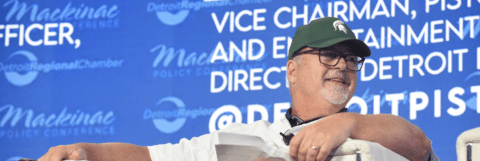
Bob Riney (BR): I chose the theme “A Quest for Common Ground” because I think we’re at such an inflection point in our country where we’ve got big issues to solve, whether it’s in the Detroit Region, the state, or the country — and those issues need healthy debate. They need the views and philosophies of different perspectives, but that need won’t be filled if we do it in an uncivil way or if we do it in a way that’s not motivated by ultimately reaching common ground.  

I felt that the timing, given all the stress in our country right now, was really important. I also felt it was important because we are one of only a few true purple states in the entire country, and we have big midterm elections coming up. I want to hear not only different parties’ and different candidates’ views, but also what their philosophy on compromise is. What is their willingness to work on behalf of the greater good, or what is the greater good from their perspective?

JM: What do you think the rest of the country can learn from Michigan as a purple state? 

BR: Purple states have to learn to listen to each other, and they have to learn to respect that there are two different philosophical views that can be pushed in one direction or the other. I think it makes both parties work harder in a good way. It makes both parties recognize that there are no slam-dunks in a state like Michigan, and you can’t take the voters for granted.  

One of the reasons elections are so expensive in Michigan is that very nature. You can’t phone it in, knowing that you already have a clear Democrat or a clear Republican in Michigan. Anything can go. It presents the ultimate debate stage for divergent views on important issues. That will get lost if we don’t do it as adults; if we do it as kids, it’s just going to look like a backyard brawl. 

JM: Well said. You’ve spoken about the responsibility of large institutions to help turn down the temperature in an increasingly divided world. How do you see Mackinac contributing to that? 

BR: I’ve always been a big believer in a concept called ‘Shadow of the Leader,’ meaning that people do watch and take their cues from leaders and how leaders behave. If out of [Mackinac], people hear very different views on a topic, different views on an approach, but they hear it described in a respectful manner and they hear it described in dialogue that’s not demonizing the other point of view, but rather emphasizing why their particular point of view is stronger or better then I think that does set the tone. That’s easy to say, hard to do. We’re all humans. I’m not naive, I’m not Pollyannish, and (I don’t believe) that everyone’s just going to convert. But we have an opportunity to show that you can have a good fight, you can have a good debate on topics, but you emerge with an approach that treats voters as adults.

JM: Right on. You’ve been vocal about the need to redesign our healthcare system to achieve better outcomes. What does bold, future-focused design look like for our state of Michigan? 

BR: I’d love to see us evolve to everyone in the state of Michigan having a deep relationship with a primary care physician and nurse practitioner or health coach. Somebody who can be with them on their journey, or a team of people who can be with them on their journey. And not only make sure that they’re getting the right coordination of care, but actually be someone who is a motivator to them that checks in on them, that helps them on their journey.  

I’ve seen the power of that when medicine is organized that way. It’s amazing what a text from a primary care physician that knows you can do, even if it’s just something like: “Hey, just wanted to check in, and see how you’re doing with your exercising.” Those little things make a big difference with people’s motivation and people feeling engaged in their own health.  

At Henry Ford, for example, with the long-term primary care physicians, our patients grieve when their primary care physician is retiring because they’ve been with them for 35 years. And what they’re really describing is “They know me,” they have a relationship they can call. That’s what I’d love to see for the state of Michigan: A really holistic approach to health.

JM: I’m from northern Michigan, and so our Saturday nights were at my grandfather’s playing euchre with a beer. How do you see new activities at the Conference this year playing into the whole common ground theme? 

BR: Well, I’m a big euchre player myself, and I grew up in a family where it was euchre and a beer all the time. I’m hoping that these activities actually allow people to sit down and get to know unusual suspects. And what I mean by that is, we oftentimes gather and congregate with the people we know, with the companies we know, which is great. It’s an opportunity to rekindle those relationships. But some activities, like euchre and others where you’re rotating around, it’s going to give us a chance to talk to some of the people at the Conference that we otherwise wouldn’t connect with and make those connections between a small business and a large business, between a CEO of a major company and a not-for-profit.

JM: My last question comes from Wendy Nodge, the Chamber’s Vice President of Signature Events and Convenings: What is your superpower? 

BR: <Laugh> I don’t know that I have a superpower, but the best compliment I get is in 45 years, I’ve had people from all different walks of life, including employees that I’ve known for a long time, say to me: “You never change.” And what’s interesting about that, and my response is always, well, I’ve actually changed a lot because, of course, my views have evolved, and my approach to things, and obviously the roles I’m in, so I’ve changed.  

But it took me a while to realize that what they really meant was your basic values haven’t changed, that you still care about all people. You still care about respecting people who disagree with you. And you care about making sure that the stuff we’re doing is really helping the communities that we serve, as opposed to just checking a box off on a goal. It really is just authenticity. I really am what you see is what you get. I don’t have a work personality and a home personality and a friend personality; that’s too complicated to keep straight <laugh>. I’m not that capable. I don’t worry about showing my whole self, no matter what crowd I’m in.

JM: Seems like good advice for people headed up to the Island. 

BR: Yes, because there are a lot of egos that get in the way of people showing their true selves, and people see through it.

JM: No doubt. Is there a message that you’d like to deliver to Conference attendees? 

BR: Take advantage of the fact that we’ve organized this so that you can have powerful education experiences, powerful free networking experiences, and powerful structured networking experiences. We believe that we’re providing something for everyone. 

James Martinez is the Vice President of Communications and Business Intelligence at the Detroit Regional Chamber.