

Photo credit: City of Detroit
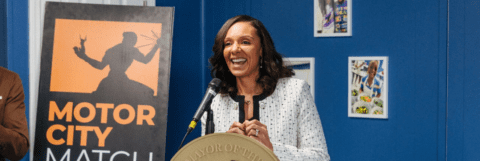
Mayor Mary Sheffield on Lessons from Detroit’s Civil Rights Movement and How Small Business and Housing Efforts Will Advance the City
James Martinez (JM): One of the things that’s not talked about enough is the great civil rights families that have led the city, state, and country from Detroit. Talk about your family’s legacy and how that impacts your leadership.
Mary Sheffield (MS): I grew up in a household that really valued social justice and civil rights. Both my grandfather and my father were legendary leaders and social activists, and that molded me at a very young age to learn how to speak up, to speak truth to power, to fight for the least of these, and to ensure that, in all that I do, I have a lens of social justice and equity.
And it molded me in the sense that every decision that I make as mayor has to be about equity, lifting up families, about continuing to fight for opportunity and justice for everyone in our city. My grandfather always used to say, ‘Never have a Wall Street mentality in a blue-collar town.’ It made me think about always centering people and everyday folks in the work that I do.
One thing about my grandfather and my father, who are definitely known for civil rights and social justice, is that they knew how to work with everyone, no matter what their background was, their race, or their party. They were liked among everyone, and they knew how to build bridges. That is something that resonated with me and that I learned from at a young age as well as in public office. It has helped me to learn how to work with people from all backgrounds to ensure that we’re fighting for social justice, racial justice, and for the betterment of the city.

“My grandfather and father, known for civil rights and social justice, knew how to work with everyone, no matter what their background was, their, race, or their party.”
– Mayor Sheffield, Mayor, City of Detroit
JM: That building bridges aspect was evident in your time as president of City Council. Knowing that the Conference theme is ‘A Quest For Common Ground,’ what are lessons Michigan can take from Detroit?
MS: Detroit’s entire resurgence and recovery was rooted in finding common ground in strong public, private partnerships, and bringing everyone together to figure out how we can move Detroit together as one, even from a regional standpoint. Detroit is leading the way in strong public, private-partnerships, ensuring that we’re finding common ground on the state and federal levels to figure out how we can better invest in our city. That is a model that can be replicated across the state.
JM: Absolutely. And one of the strong investments you’re making, is in small businesses. What type of impact do you see that having on the city?
MS: Small businesses are the backbone of our economy in Detroit. We have a myriad of small businesses, particularly those who have been operating legacy businesses for over 30 years. But oftentimes, when we talk about investing in small businesses or supporting small businesses, we forget about those that have been here for generations, that are part of the social and cultural fabric. If we invest in those businesses, then it also preserves the history and culture of our city.
We are trying to make it easier to do business in Detroit, cut red tape, reduce regulations, improve some zoning, and better cultivate the growth of small businesses. You want Detroit to be the best place to start and grow a business, and part of that is not just attracting new businesses to Detroit, it’s also making sure that those that are here can grow and scale.

Photo credit: City of Detroit
JM: Agreed. A past conference theme was “The Power of &,” and the more we adapt that mindset with economic development, from the big and the small businesses, is a good thing. You have also emphasized housing and specifically, Community Development Black Grant (CDBG) funds. How do you see that helping address housing in the city?
CDBG funds have been instrumental in our overall ability to preserve and build new housing in Detroit. Unfortunately, over the last 12 years or so, we’ve seen a decline. CDBG dollars historically have allowed us to partner more with the private sector to attract more funding to support the development of housing. [With less funding now however,] we’ve been very innovative in how we approach it.
We have a goal of building 1,000 new single-family homes within four years of my first term. We are working with many different entities and developers to make that a reality, but we want to continue to provide as much affordable housing in our city and also address the issue of home repair grants, which a lot of our residents have, because Detroit has some of the oldest housing stock in our state and the country. Providing access to repairs is another way to provide relief for Detroiters.
JM: What do you need from the business community to continue the city’s momentum?
MS: The business community has been a great partner. I am a firm believer that people need business and business needs people. I want the business community to understand that as we invest in people, that is an investment in business because when people are thriving and doing well, they can support them in our city. And when business is doing well, it supports our residents. The more that we can continue to partner, have intentional investment, and then focus on taking the business growth deeper into our neighborhoods, the more we can move forward in Detroit.
JM: Those seem like two areas off common ground heading to the conference. What did we not talk about that you want attendees to know?
MS: We are doing retail attraction in the city in a way that has not been done before. We are hiring a new Director of Retail Attraction. We’re focusing on both local and national retail, and it is good not just for Detroit but also the Detroit Region. Detroit is open for business, and the real effort and work that we’re doing around making it seamless and easier to develop in Detroit, and our work around reducing property taxes is underway.