

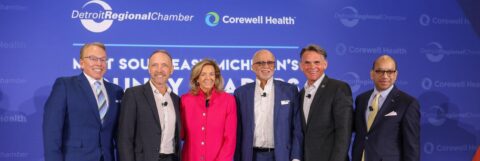
During a moderated discussion led by CBS Detroit and Detroit Free Press’s Carol Cain at the Detroit Regional Chamber’s 2026 Meet Southeast Michigan County Leaders event, county executives from Macomb, Wayne, and Oakland counties discussed their shared challenges and responsibilities, which are key to shaping Southeast Michigan’s future. While each county faces distinct pressures, the conversation underscored a common reality that the Detroit Region’s success depends on coordinating leadership across infrastructure, economic development, and quality of life.
Watch the event video below.
Strong Financial Foundations Power Strategic Investment
Macomb County Executive Mark Hackel opened the conversation by emphasizing infrastructure as the county’s top priority, grounded in long-term fiscal discipline that has led to his county’s dramatic economic growth over the last 15 years, noting its evolution into a $57 billion annual economy. Just as importantly, he stressed that financial stewardship has positioned the county to invest with confidence in areas its citizens want, addressing the affordability crisis felt across the state.
The county conducted a comprehensive survey across municipalities to understand local housing needs and gaps, using that data to pursue targeted funding and “attainability” strategies rather than one-size-fits-all solutions.
“We did a survey throughout the entire county to get an understanding of what’s happening within each of those municipalities and what we can be doing better by partnering with them.” Hackel said, “We have taken more of a supportive lead role to try to figure out how to help each one of those communities provide affordable opportunities for people … I kind of look at [housing] as more of an attainability [problem].”
Oakland County’s Outlook: Headwinds and Downtown Revitalization
Oakland County Executive Dave Coulter offered a candid economic outlook, acknowledging that while his county remains a major engine of growth, there are warning signs.
Recent forecasts show national and state economic headwinds, and Coulter noted that both population and economic growth “could be growing more.” In response, Oakland County is doubling down on place-based investment, including the recently announced decision to relocate 700 county employees back to downtown Pontiac. The move is already catalyzing momentum, with $500 million in private development projects now in the pipeline. Coulter emphasized that the county’s role is not to “save” Pontiac, but to serve as a catalyst by creating conditions that attract residents, developers, and employers alike.
“My overall goal is to make sure that Oakland County, which is a great place if you’re wealthy,” he said, “but I want it to be a great place for everyone.”
Regional Transit: A World-Class Region Requires a World-Class System
One of the most talked-about collaborations within the Detroit Region is transit, especially the upcoming Wayne County transit ballot initiative in August. Wayne County Executive Warren Evans explained why it is structured as an all-or-nothing proposal. With 17 of roughly 40 communities currently opting out, he argued that the Region does not have a true, viable system, and decisive action is needed to make it fully viable.
To be both attractive and competitive, Evans said, “if we’re going to be a world-class Region, then we have to do real world-class solutions,” and that starts with transit. Despite differing visions of what a connected Region looks like, including trains, buses, and microtransit, Evans expressed confidence that a future transit system will be data-driven and shaped by community input, not imposed from the top down.
Hackel expanded on that point, explaining that constant communication with northern and suburban communities in Macomb County has been essential to building trust and increasing transit use. As he put it, “SMART keeps getting smarter.”
Coulter reinforced the results from within Oakland County’s north and west service areas, saying that ridership has increased by more than 100% — highlighting that when service improves, people use it.
When asked what else the counties collaborate on, Hackel pointed to road funding as a major success story that is akin to transit. Through sustained collaborative advocacy, the counties secured a more sustainable funding model for local roads to address everything from “from the driveway to the highway,” as described by Hackel.
Whether addressing transit, affordability, infrastructure, or global competitiveness, the three counties’ executives made clear that Southeast Michigan’s future depends on coordination, trust, and shared leadership.
As the Region continues to evolve, the executives’ message remains clear: when these three counties work together, Southeast Michigan is stronger for residents, employers, and the next generation alike.