

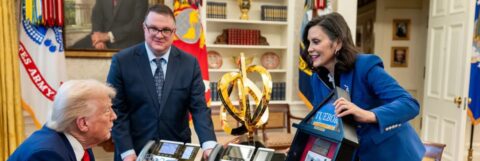
Photo credit: The White House
In the Detroit Regional Chamber’s February 2026 Michigan Voter Poll, Michiganders overwhelmingly said they want both Republicans and Democrats to compromise to address problems facing Michigan. And over the recent years of Michigan’s history, Michigan’s legislators have shown how they have worked across the aisle to achieve significant results for Michigan and its residents.
Auto Insurance Reform in 2019
Michigan’s no-fault auto insurance system of 1979 was at one point a severe, partisan issue in the state due to unique coverage requirements, resulting in the highest insurance rates in the nation and decades of debate to fix the issue.
Despite pressure and the majority power to pass partisan-driven bills in 2018 and 2019, then-Speaker Lee Chatfield and then-Senate Majority Leader Mike Shirkey — both Republicans — worked closely with Democratic Gov. Gretchen Whitmer to develop a bill that would gain majority support from both sides of both Congressional branches.
During the 2019 Mackinac Policy Conference, Whitmer signed the historic auto insurance reform, which lowered costs for Michigan drivers, gave them more choice in Personal Injury Protection medical coverage, and saved about $357 per vehicle, while increasing the number of insured drivers in the state.
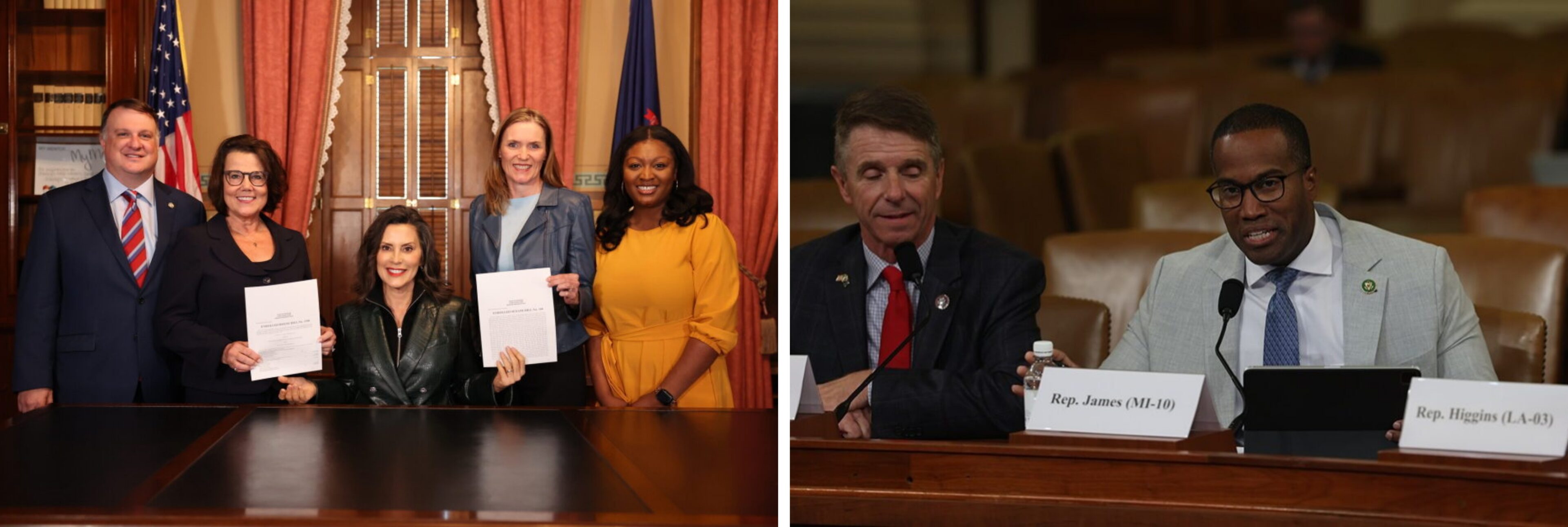
Pictured left to right: Speaker Matt Hall, Rep. Ann Bollin (R-Brighton Township), Gov. Gretchen Whitmer, Senate Majority Leader Winnie Brinks, Sarah Anthony (D-Lansing); U.S. Rep. John James (R-MI 10)
Securing Selfridge’s Future in 2025
With the aging A-10 fighter jet slated for retirement, business and government leaders needed to work across the aisle to protect the state’s defense capabilities and the precision manufacturing jobs by increasing production of the F-15EX fighter jet and flying missions from Selfridge Air National Guard Base in Harrison Township.
Key players in this bipartisan effort were U.S. Rep. John James (R-MI 10), who submitted an amendment to the authorization for National Defense in 2023 to increase capacity to build the jets, along with Whitmer and Republican Speaker Matt Hall, who traveled to the White House to solidify the deal with Republican President Donald Trump in Spring 2025.
“We came up with a common agenda,” said Hall on WJR 760-AM on Feb. 25, 2026. “We wanted to help Selfridge National Guard Base to survive another 30, 40 years with the new fighter mission. We also wanted to protect the Great Lakes from the invasive species — the Asian Carp — and we also wanted to work together to help Michigan with an ice emergency in Northern Michigan.”
Earned Sick Time Act and Minimum Wage in 2025
In 2024, the Michigan Supreme Court ruled that the Michigan legislature’s adoption and amendment of a 2018 proposal were unconstitutional. The decision encompassed many complex adjustments to earned sick time benefits, a rapid schedule change to minimum wage increases, and a phase-out of the tipped wage credit requiring restaurants to pay the full minimum wage by 2030.
Within an hour before ESTA was to take place, the legislature compromised through amendments such as Republicans’ later compliance dates for small businesses, Democrats’ 72-hour paid leave requirement for large employers, and both parties’ sick-time “front loading.” Further, Democrats accelerated their $15-an-hour pay goal to 2027, while Republicans blocked the full phase-out of the tip credit.
Roads Funding in the FY26 Budget
Another significant win for common ground in Michigan came in 2025 over another long-term battle over how the state would fund state and local road repairs.
In their respective proposals, Hall and House Republicans pushed to reallocate existing state tax revenue rather than introduce broader new taxes on residents, while Gov. Whitmer, Senate Majority Leader Winnie Brinks, and Senate Democrats sought “new” revenue streams to protect the state’s general fund and social programs from deep budget cuts.
Both sides met in the middle by having the School Aid Fund backfilled by other sources to prevent cuts and through the Neighborhood Roads Fund, which included local roads for repairs through increased marijuana and corporate income taxes. Whitmer signed this deal as part of the FY26 budget in Fall 2025.