Detroit Regional Chamber > Chamber > Gordie Howe? A Look Back on the Chamber’s Advocacy for the New International Bridge

Gordie Howe? A Look Back on the Chamber’s Advocacy for the New International Bridge

December 24, 2025 Jim Martinez headshot

Jim Martinez | Vice President, Communications and Business Intelligence, Detroit Regional Chamber

For more than a decade, the Detroit Regional Chamber has advocated for a third connection between Detroit and Windsor – the busiest northern border crossing between Canada and the U.S. – and a key hub in one of the densest, most interconnected transportation and trade corridors in North America.

That leadership is coming to fruition as both the U.S. and Canadian sides of the border prepare to open the Gordie Howe International Bridge in 2026, which will create a new critical artery for one of the world’s largest trading partnerships.

“The long-enduring and lucrative trade relationship between Canada and the U.S. is one of our nation’s most important and central to our economic competitiveness and prosperity,” said Sandy K. Baruah, President and Chief Executive Officer of the Chamber, in explaining why the Chamber pushed so hard for the new border crossing.

Hard Work Preceded the Cranes

While the Bridge work in recent years has largely been focused on construction, the earliest – and arguably most challenging – lift did not involve cranes or engineers at all.

It involved finding a way to move the project forward in the immediate years following the Great Recession with formidable, deep-pocketed opposition and a cash-strapped state legislature.

“This new crossing has been the Chamber’s top infrastructure priority for years, and we put everything we had into making it a reality,” Baruah said. “We can’t overstate what the Gordie Howe International Bridge means to our members, particularly those in automotive, advanced manufacturing, and the supporting supply chain.”

Gorde Howie Bridge

“This new crossing has been the Chamber’s top infrastructure priority for years, and we put everything we had into making it a reality. This critical infrastructure is a game-changer and will drive economic growth in Michigan for decades to come.”

– Sandy K. Baruah, President and Chief Executive Officer, Detroit Regional Chamber

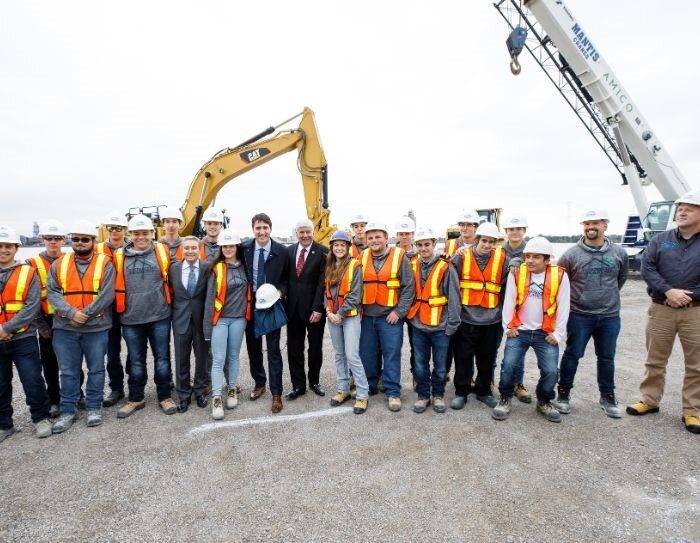
On October 5, 2018, Canadian Prime Minister Justin Trudeau (middle left) and Michigan Gov. Rick Snyder (middle right) mark the official start of construction for the Gordie Howe International Bridge project.

On October 5, 2018, Canadian Prime Minister Justin Trudeau (middle left) and Michigan Gov. Rick Snyder (middle right) mark the official start of construction for the Gordie Howe International Bridge project.

Protecting One of the Region’s Largest Economic Assets

With more than 200 million people and approximately $500 billion in goods moving across the Canadian-U.S. border annually, maintaining that flow had been a long-standing Chamber priority since the early 2000s.

Michigan accounted for more than half of the total U.S. trade with Canada, with almost all of it coming via the Detroit and Port Huron international border crossings. In 2008, total trade between Michigan and Canada exceeded $67.4 billion, with Canada serving as the state’s most important trading partner.

Protecting that flow from congestion and delays gained prominence during and after the Great Recession, as did worries about the capacity of Michigan’s infrastructure. The Chamber began to emerge as a vocal advocate for the project and a supporter of the Detroit River International Crossing (DRIC) Report, which reaffirmed support for the project by providing traffic numbers to the legislature to clarify the need for a second span.

Elevating the Project’s Importance in the Face if Legislative Opposition

Despite the strong business case for another span, the project met strong political headwinds in a state still reeling from the Great Recession.

In order to move the project forward initially, the Michigan Legislature needed to pass legislation enabling the state to enter an agreement with Canada to build it, create a public-private partnership to finance it, and collect tolls to pay for the Bridge.

Operating one of the most well-respected advocacy offices in Lansing, the Chamber continued to rally the business community around the project and pressure lawmakers as it became known as the New International Trade Crossing (NITC).

The Chamber’s Leadership on This Project:


  • Raising awareness about the economic impact of the Detroit-Window border crossing and the need for a new crossing.


  • Advocating for the state legislature to move the project forward amid still opposition.


  • Supporting then-Gov. Rick Snyder’s efforts to partner with the legislature and then Canada to move the project forward.


  • Opposing Proposal 12-6, which could have undermined the project, and educating Michigan voters who soundly rejected the ballot proposal in 2012.

Against Long Odds, a Chamber-Endorsed Governor Finds a Way

The Detroit Regional Chamber, including Brad Williams, played a key role in opposing a ballot proposal that could have undermined the new bridge project.

With the Legislature blocking the way, the Chamber would find a Bridge champion in then newly elected Gov. Rick Snyder.

After remaining non-committal on the project during the 2010 election, Snyder, whom the Chamber had endorsed early and loudly in a crowded Republican primary, eventually called for the Bridge to be built in his first State of the State Address.

Snyder also kicked off the 2011 Mackinac Policy Conference, calling for the Bridge to be built.

“The Mackinac Bridge has been a shining example of what a modern bridge can do for our state,” said Snyder, wearing a “Build the Bridge” pin and speaking at a press conference with Baruah and other leaders on Grand Hotel’s porch at the Conference.

“[The Mackinac Bridge] has lived up to its expectations,” Snyder added. “Now it’s time to build a new bridge to Canada that will provide efficient and reliable infrastructure to the largest trading partner of Michigan and America.”

With Snyder ultimately finding himself blocked by the Republican-led legislature, he would take executive action in June 2012, reaching an agreement directly with Canada to move the project forward. Under the agreement, Michigan was not obligated to immediately pay any of NITC’s costs, and no state appropriation was needed, allowing the move to circumvent the legislature.

NITC Roundtable

The Chamber hosted the U.S. Department of Homeland Security Secretary Jeh Johnson and then-U.S. Rep. Gary Peters, in addition to other high-ranking officials, for a roundtable discussion on the proposed trade crossing in May 2014.

“Gov. Snyder stuck his neck out for this project,” said Brad Williams, former Vice President of Government Affairs at the Chamber, who  held that position during much of the advocacy to build the Bridge. “He kept running into obstacles in the legislature, and it took a lot of political courage to push for the new bridge. It would have been easier to just walk away and point the finger at the legislature.”

As part of the agreement, Canada’s payment of $550 million on the project was eligible for matching U.S. federal funds, as tolls charged in Canada would be used to reimburse the Canadian government. The Canadians would also pay for land acquisition in Canada and Michigan, as well as the construction of an interchange to connect the NITC to I-75.


Fighting Off Proposal 12-6 Push to Ensnare the Project in the Michigan Constitution

With the Bridge project gaining momentum, another challenge would emerge with Proposal 12-6 on the ballot in the November 2012 election. Proposal 12-6 stated that any new bridge crossing between the U.S. and Canada should be approved by the people through a constitutional amendment, and if passed, could have undermined Snyder’s deal.

Seeing the threat to its top infrastructure priority, the Chamber became the face of opposition to Proposal 12-6, going to the media and raising voter awareness about voting “no.”