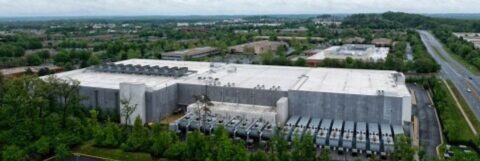
An example already in action is Virginia, now known as the world’s largest data center market. Its data centers in just Loudoun County account for nearly half of all property tax revenues, generating $16 billion in new value in 2024 alone, for a total of $41 billion, and supporting over 12,000 local jobs.
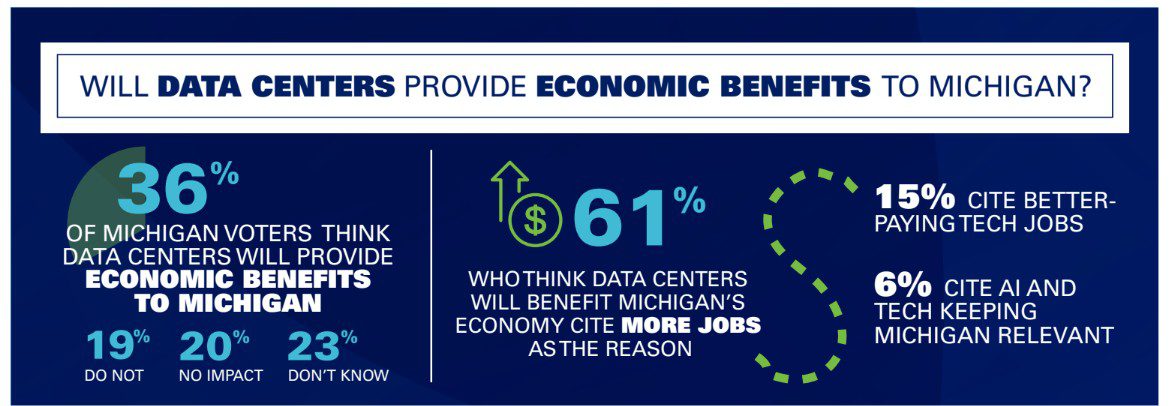
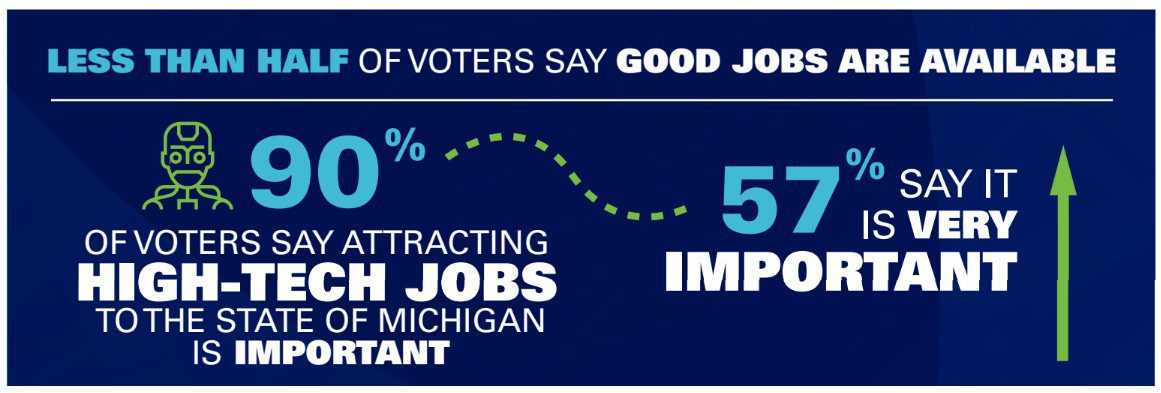
Yet in the Detroit Regional Chamber’s Michigan Voter Poll in February 2026, 66% of Michigan voters did not have a position on data centers, despite the fact that over 90% say attracting high-tech jobs to the state is important — a disconnect Michigan needs to address to thrive in the innovation economy.
“It’s very clear that Michiganders don’t know what data centers are, what they do and what the value of these are,” Chamber President and Chief Executive Officer Sandy Baruah recently told Crain’s Detroit Business.
Time for Honest, Fact-Based Conversations
Virginia’s economic success from data centers is the type of diverse industry growth Michigan has sought for decades. Unfortunately, media coverage of opposition to data centers, especially Oracle’s Saline Township project, has drown out the economic benefit conversation among those who are even aware of the centers, which is only a little over half of voters, according to the Chamber’s February poll.
“It would serve Michigan really well to have a conversation about both sides so people fully understand what’s at stake for and against data centers,” Richard Czuba, The Glengariff Group, Inc.’s President, said on WJR 760 AM on Feb. 25, 2026. “Because right now, the narrative is being steamrolled by those opposed to data centers.
Construction Jobs and Building the Tax Base
Spanning across only 250 acres, the Saline Township project is expected to create 2,500 3,000 union construction jobs and 450 well-paying, permanent jobs, plus 1,500 support roles for Washtenaw County, according to Oracle.
Additionally, having data centers in Michigan and close to Michigan businesses means that industries that heavily rely on data, like the health care sector, can have quicker data transmission and strengthen security for especially sensitive data.
Further, the Saline Township project is expected to bring a serious boost in tax revenue, according to Rakolta.
“The current property taxes today are somewhere in the neighborhood of $150,000,” Rakolta said at the Conference. “When that [Saline Township] facility is done, the property taxes will swell to $25 million. That’s $25 million that Saline Township doesn’t have today.”
Tech Advances Making Centers More Ecologically Friendly
One of the biggest concerns with building new data centers is impact on resources, especially water. Today’s data centers use cutting-edge technologies that consume fewer resources than older data centers. When complete, the Saline Township AI data center will use a one-time-fill, closed-loop, non-evaporative liquid-cooling system that operates similarly to coolant systems in automobiles — a serious, energy-reducing upgrade from chilled-water systems in data centers built at least a decade ago.
The Saline Township project will also be served by existing high-voltage power lines, which will have sufficient capacity to run the one-gigawatt (1,000 megawatt) AI data center. Oracle has said it will pay for the required energy infrastructure upgrades and contribute its share to the fixed costs of maintaining and improving the grid, estimated at approximately $300 million annually.
“When those customers show up at our doorstep, we understand their needs; we understand their demand, and we make sure we have the infrastructure in place that can support them,” Joi Harris, DTE Energy’s President and Chief Executive Officer, explained at the 2026 Detroit Policy Conference. “And they have to cover the cost of that infrastructure if it’s incremental to what we already have.”
Harris echoed the view of data centers as an economic development opportunity and explained how data centers spread fixed costs across the baseload which will keep costs to other consumers down.
“It really is an exciting time,” she said. “We’ve got to go a long way in convincing people that this is a good thing and dispel some of the misinformation and fear that’s out there.”