Recap: Sandy K. Baruah Guest Hosts ‘Focus With Paul W. Smith’ on WJR 760 AM, Feb. 25
February 27, 2026
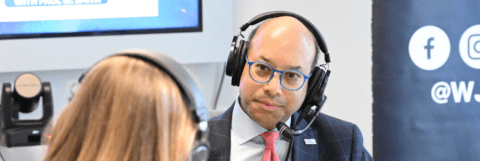
On Feb. 25, Detroit Regional Chamber President and Chief Executive Officer Sandy K. Baruahfilled in for Paul W. Smith as a guest host of WJR 760 AM’s Focus With Paul W. Smith, interviewing several prominent leaders in the Detroit Region as they awaited Governor Gretchen Whitmer’s final State of the State address.
Hear what the guests had to say below.
Senate Majority Leader Winnie Brinks: Dual Enrollment Is a ‘Win for Talent and Business’
Winnie Brinks is the Senate Majority Leader for the State of Michigan, representing the Grand Rapids area. As Brinks experiences her last upcoming State of the State Address as a sitting senator, she reflected on the successful areas, from quintupling the earned income tax credit to offering affordable housing to investing in more dual enrollment.
One area of particular focus for Brinks is dual enrollment, noting that it is not just beneficial but critical for Michigan’s future. She argues that expanding access to dual enrollment is an urgent step that will prepare and empower students to enter the workforce sooner, with less debt, and immediately strengthen the state’s talent pipeline.
“It’s an overall, great investment, not just for them as an individual, but also for companies that are going to be looking to hire those folks,” Brinks said.
Sen. John Damoose: We ‘Need to Build’ on the State’s Identity That Made it Successful in the Past
Sen. John Damoose (R-Harbor Springs) has earned a reputation for his bipartisan approach to economic development policies, particularly recognized for his collaboration with Michigan Sen. Mallory McMorrow (D-Royal Oak) to develop innovative, bipartisan solutions for the state’s economy.
Damoose also discussed his experience as a member of the U.S. Senate Committee on Appropriations and offered guidance on creating a successful long-term economic development policy in Michigan.
“We realize that the State of Michigan doesn’t have much of a long-term strategy for where we want to be investing our money,” Damoose said. “We need to remember who we are. We used to know [that] as a state, we built great things and played outside all year round. We can’t say that anymore.”
House Minority Leader Ranjeev Puri: We ‘Can’t Afford to Politicize’ EVs, Next Gen Technology
Ranjeev Puri is the House Minority Leader for the State of Michigan, known for serving on the finance team for Former President Barack Obama and having his finger on the pulse when it comes to the automotive and mobility industry, especially in Michigan.
During his time on the program, Puri said today’s inconsistent and politicized strategies regarding electric vehicles (EVs) and other new technologies are keeping Michigan from remaining competitive, and there needs to be a shift to an intentional strategy that keeps the state ahead of the curve.
“Is this a technology that we want to be on the forefront, or do we again want to fall victim to other people leading the way and us playing catch-up and not being able to dictate how this is going to play out in our own backyard?” Puri asked. “These aren’t conversations that we shouldn’t be burying our heads in the sand and think they’re going to go away. These are things that we should be really trying to be on the forefront of.”
Senate Minority Leader Aric Nesbitt: ‘It’s Just More Expensive to Live in Michigan’
Michigan Senate Minority Leader Aric Nesbitt is Michigan’s Senate Minority Leader, representing the 20th District, which includes portions of Berrien, Van Buren, Allegan, and Kent counties, since 2018. He has also thrown his hat in the ring in hopes of becoming Michigan’s next governor in 2026.
During his time on the program, Nesbitt shared some of his experiences on the gubernatorial campaign trail, telling Baruah he’s spotted a few common worries spread across Michigan’s communities despite income levels: increasing expenses and “cumbersome bureaucracy.”
“They want more money left in their pockets,” Nesbitt said. “It’s the cost of living — ‘Lower the cost of my energy bills, lower the cost of my groceries, lower the cost of housing. It’s just tough. The property tax is tough to make it here in Michigan.’ Job creators around the state, whether you’re in Holland or Taylor or up north, are complaining about the cumbersome bureaucracy and the mandates coming out of Lansing.”
Richard Czuba: February 2026 Michigan Voter Poll is ‘Most Eye-Opening’ Yet
Richard Czuba is the founder of the Glengariff Group, Inc. and brings more than three decades of expertise in survey and focus group research, issue management, and strategic planning with all levels of government and public sector organizations. He also serves as the Chamber’s lead pollster, partnering with the Chamber to provide a quarterly Michigan Voter Poll to reveal citizens’ perceptions — and sometimes misperceptions — about timely issues.
The latest Michigan Voter Poll, released on Feb. 23, 2026, revealed more misperceptions on the state’s performance on six key metrics nationally. Voters across the political spectrum incorrectly view Michigan as “average” on key economic and education measures despite its near-last rankings. During his time on the program, Czuba called for leaders across industries to “start having the tough conversations.”
“When you look at Michigan’s decline — 16th in 2000 to 40th today — both parties have had the governor shift during that period,” Czuba said. “Neither party, neither side wants to get blamed for this [decline]. So, there’s limited conversation with the voters on this. I think this is going to take a lot of organization. … Michigan really needs to acknowledge it … that’s going to require everyone … and that’s not always to the advantage of political leaders or organizations.”
Jim Holcomb: ‘Time for All to Take Action’ to Solve Michigan’s Challenges
Jim Holcomb serves as the President and Chief Executive Officer of the Michigan Chamber of Commerce, leading the organization’s mission to help protect, connect, and strengthen Michigan businesses while advancing policies that foster a strong economy, vibrant communities, and opportunities for all Michiganders.
During his time on the program, Holcomb shared what he’s been hearing from Michigan’s business community and their concerns. Though businesses remain optimistic by nature, they want to make sure policymakers continue to move forward and find meaningful solutions for things like education and economic tax structures, and everything else in between. Holcomb encouraged “more statesmen rather than politicians,” saying the fight to improve Michigan will be “an uphill battle worth raging.”
“Michigan has challenges, but it’s nothing we can’t overcome; we just have to be serious about it,” Holcomb said. “It’s time to put a stake in the ground to take action. We can’t accept the status quo anymore. We’ve talked about these problems for decades and it’s time to have meaningful solutions put forward …”
House Speaker Matt Hall’s Collaboration With Governor Whitmer to Produce Results For Michigan
Speaker Matt Hall is serving his fourth term representing the 42nd House District, which includes portions of Kalamazoo and Allegan counties, and has been Speaker of the House for the 103rd Legislature.
In his interview, Hall said he and House Republicans are focused on making life more affordable for Michiganders, providing value for taxpayer dollars, and restoring trust in government. He highlighted the new tax reform that he has proposed, how it would work, and how Michiganders would be affected.
“What I’m proposing is the biggest tax reform in Michigan’s history. I’m proposing getting rid of the state property tax, I’m looking at getting rid of the personal property tax, and we’re looking at the utilities,” Hall said. “What we’re doing here: we’re lowering property taxes, we’re making things more affordable at the store, and we’re getting rid of the utility costs, and we’re cutting your utility rates too.”
Megan Spanitz and Glenn Stevens Jr. Discuss Chamber Efforts and What the Industry Needs From Government
Working alongside Baruah at the Detroit Regional Chamber, Chief Strategy Officer and Chief Operations Officer Megan Spanitz and MichAuto Executive Director and Chamber Chief Automotive and Innovation Officer Glenn Stevens Jr. are vital to the operations of the organization. Spanitz explains that balancing her dual roles is made smooth for her this way:
“It’s the team, the team, the team. And we have a very strong team, best in class,” she said. “I also think we need to move at the speed of light. We need to think like entrepreneurs. When there’s an idea, capitalize on it, and if it doesn’t work, fail fast, or fail forward, is our new slang.”
When discussing the automotive and mobility industry, Stevens explained that China is a leader in the electric vehicle (EV) industry right now and highlighted what Michiganders might be surprised to see in how their vehicles function.
“The speed to market, the innovation they deploy, everything from AI to design the vehicle to advanced manufacturing is unparalleled. It’s world-class. Number two, the vehicles are high quality. Number three, they are full of tech. They connect seamlessly to things, and that’s what consumers want. So they are as much the gold standard as any automotive company is in the world right now.”