
- Election stability drives economic stability. Trust in elections directly affects investment, policy predictability, and business confidence.
- Businesses should inform, not advocate. Employers can reduce uncertainty by sharing clear voting information and encouraging participation while being nonpartisan.
- Engagement strengthens resilience. Sustained civic participation is the strongest safeguard for both economic growth and democratic stability.
The 2026 Elections and a Competitive Economy: What Business Leaders Need to Know
May 26, 2026
Krishaun Burns |
Top Takeaways
As Michigan enters a major 2026 election cycle, business leaders are navigating more than campaign dynamics. They are confronting how political uncertainty, institutional trust, and civic engagement shape economic competitiveness.
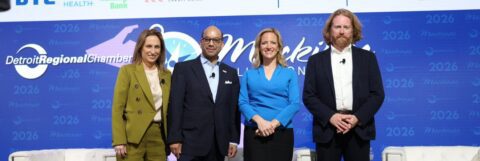
During a 2026 Mackinac Policy Conference session, leaders from government, industry, and civic organizations explored how election integrity, policy stability, and business engagement intersect in shaping Michigan’s economic outlook. A core theme quickly emerged: elections are not just a civic exercise — they are a business issue.
Moderator Daniella Ballou-Aares of the Leadership Now Project outlined three key risks tied to election cycles: market volatility, operational disruption, and reputational harm if trust in democratic systems falters. These risks can emerge before, during, and after Election Day, from misinformation and funding challenges to threats against poll workers and disputes over certification.
While rare, these pressures reinforce a broader reality: confidence in elections is foundational to economic stability.
View the full video below.
Speakers


Stability, Policy, and Investment
That connection was reinforced by the Detroit Regional Chamber’s Sandy K. Baruah, who emphasized the importance of strong public, civic, and private institutions, or what he described as “the strength of the commons.”
“If we don’t have that strong foundation — and elections, trust in elections is certainly a big piece of that — then the rest of it falls apart,” he said, noting that uncertainty “leads to an unstable, uncertain investment environment.”
He added that policy volatility, particularly tariffs, has already constrained investment in Michigan’s auto and mobility sector, underscoring how instability can directly impact growth.
State Leadership and Economic Confidence
As uncertainty persists nationally, panelists emphasized the role of state leadership in providing clarity.
Michigan Secretary of State Jocelyn Benson drew a direct connection: “You can’t have a healthy economy if you don’t have a healthy democracy.”
She pointed to Michigan’s focus on transparency, security, and voter access as key to building public confidence, with a goal of ensuring “no matter what you’re hearing at the federal level, everything’s going to be okay right here in Michigan.” State Leadership and Economic Confidence
Navigating Risk While Strengthening Trust
For business leaders, the message was clear: avoid short-term reactions and focus on long-term credibility.
Former U.S. Rep. Peter Meijer cautioned against overreacting to rapidly shifting political moments, noting that “businesses should be thinking and focusing on the long term,” rather than the “24-hour news cycle.”
At the same time, businesses cannot remain entirely on the sidelines when misinformation affects employees and operations. Baruah noted that “your employer is always amongst the top, if not the top source, for trusted information.”
Rather than taking political positions, the panel encouraged business leaders to:
- Share clear, factual information about voting
- Direct employees to credible, nonpartisan sources
- Encourage civic participation, including voting or serving as poll workers
“You can do that without having to weigh in on the issue of the day … you can just talk about, proactively, this is what you need to know to vote,” Benson said.
Engagement as the Antidote to Uncertainty
Panelists emphasized that engagement is what strengthens both democracy and economic resilience.
Benson pointed to increased voter turnout and stronger election systems as evidence that engagement works, even amid heightened challenges. She noted that it can be one of the most effective ways to build trust, allowing individuals to “see firsthand what’s real.”
Conversely, she warned that fatigue poses a growing risk.
“The worst thing we can do in this moment is check out,” Benson said, calling on business and community leaders to remain engaged.
Preparing for What’s Ahead: A Shared Responsibility
Looking ahead to the remainder of 2026 and beyond, the panelists were clear: the pressures on democracy and the economy are unlikely to ease.
From misinformation to emerging technologies like AI, the environment is becoming more complex, requiring continued collaboration between business, government, and civic leaders to maintain competitiveness.
At the same time, sustaining progress will depend on more than policy alone. It requires strong democratic systems, consistent leadership, and active participation across sectors.
For Michigan, that collaborative approach has already strengthened both elections and economic resilience. The challenge now is sustaining that momentum, ensuring that trust, engagement, and stability remain central to both the state’s democracy and its economy.
This session was hosted by the Leadership Now Project.