
Photo Credit: Jeff Kowalsky/Detroit Economic Club
The Fed’s Austan Goolsbee on Inflation Risks, Fed Independence, and the Next Supply-Chain Test
April 8, 2026
Anjelica Miller |
Top Takeaways
- The Federal Reserve’s independence is a key inflation guardrail, so politicizing rates risks stickier inflation.
- A “low hiring, low layoffs” labor market signals uncertainty and delayed decisions.
- Michigan faces outsized tariff exposure; higher fuel costs could pressure just-in-time supply chains.
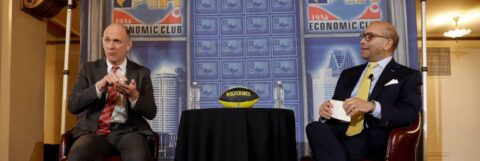
As the business community weighs hiring and pricing decisions for the second half of the year, a central question is re-emerging: are inflation risks truly receding or just regrouping? At the Detroit Economic Club’s April 2026 meeting, the Chamber’s Sandy K. Baruah and the Federal Reserve Bank of Chicago Austan Goolsbee, President of the Federal Reserve Bank of Chicago, argued that overlapping shocks — from tariffs to potentially higher energy costs — are making the outlook less “textbook,” and more like the kind of uncertainty that can stall hiring and squeeze supply chains.


Federal Reserve Must Remain Nonpartisan and Independent
Kicking off the conversation, Goolsbee reminded the audience of the Fed’s structure and its nonpartisan, independent nature, which serve as core guardrails for price stability with inflation. Goolsbee explained that the Federal Open Market Committee (FOMC) is structured to focus on “stabilizing prices [to] maximize employment,” so rates aren’t set solely through a Washington or Wall Street lens.
“If they’re actively talking about taking away the independence of the FOMC, …that is a recipe to have inflation come roaring back,” Goolsbee said. “When you have political control over that inflation… people don’t like it.”
A “Not-a-Cookbook” Economy
Goolsbee described today’s economy as “not a cookbook,” meaning it doesn’t fit the pattern of a normal recession, but growth is clearly cooling. He pointed to 2023 as the key backdrop—inflation fell sharply without the kind of broad downturn that typically accompanies that progress. More recently, however, inflation has hovered closer to 3% and could drift higher, even as companies hold back on hiring. He also warned about the risk of a “stagflationary” hit—when costs rise at the same time growth slows—especially if a “tariff-driven price bump” lingers and is followed by higher energy prices. In that environment, the path for interest rates is less predictable, and day-to-day business conditions can become more volatile.
“My concern at this immediate time is that we’ve got to get our heads around an oil shock, which is going to drive up prices in a ‘stagflationary’ way, potentially, before the other one has gone away,” Goolsbee said. “So that the prices spiked from tariffs, and then they were supposed to go away. And this is now hitting before that went away. And that’s eerily reminiscent of that period where the COVID supply shock damage happened.”
Consumers are the “Wild Card” of the Economy
In conclusion, Goolsbee noted that Michigan is among the country’s most tariff-exposed states, and even with partial exemptions, uncertainty remains for suppliers and OEMs making sourcing, pricing, and production decisions. He also pointed to a familiar pressure point in a just-in-time environment: if fuel prices rise, freight costs rise with them, and disruptions become more likely when critical parts aren’t sitting in warehouses but moving across the Region on trucks. And while autos are at the center of that risk, he cautioned that agriculture and other industries dependent on petroleum-based inputs are also feeling the squeeze. He then said, “The wild card is the consumer,” who continues to spend even when confidence surveys suggest otherwise.
“So there are definitely challenges. That said, the economy continues to grow,” Goolsbee said. “And can I tell you, the most important thing, the driver of growth for the last three years in the U.S. economy … been the U.S. consumer chugging along every six months in their consumer sentiment measures. They say, ‘it stinks. It’s the worst. I hate it.’ And yet they continue spending, and their incomes have been maintained. So as long as that remains true, I’m still basically optimistic that the boom can continue.”