Detroit Regional Chamber > Advocacy > Live From Mackinac Brought to You by DTE Energy, May 27

Live From Mackinac Brought to You by DTE Energy, May 27

June 5, 2026

During the 202Mackinac Policy Conference, “Live From Mackinac Brought to You by DTE Energy” featured on-air discussions with Michigan legislators and industry leaders on current political and economic issues. Sponsored by DTE Energy, this popular three-day program was hosted throughout the Conference in the Parlor at Grand Hotel, with the Detroit Regional Chamber’s Brian J. Shoaf as emcee. 

Catch up with May 27’s conversations below.

Kicking off the second day of conversations, Michigan Public’s Rick Pluta sat with Richard Czuba of The Glengariff Group, Inc., to further discuss the findings from the Chamber’s latest Michigan Voters Poll. Discussing how Michigan’s house is on fire, Czuba implored Michiganians to not “believe your lying nostalgia for Michigan” and to diversify our economy beyond manufacturing. 

“Michigan has always been above average … a state of growth. Nobody’s telling voters it’s not anymore,” Czuba said. “Nobody’s telling voters there’s a problem. So they’re living on a nostalgia of what we were in Michigan, or what we’ve always been. … No state over the last 25 years has fallen more in per capita income than Michigan, and that is because other states are not as nostalgically wedded to manufacturing jobs as Michigan.” 


In a conversation with Rick Pluta of Michigan Public, State Rep. Nancy Jenkins-Arno and Michigan Sen. Ruth Johnson highlighted the key to improving Michigan’s workforce development: education. Referencing Michigan’s falling ranking in education and students’ inability to read and do math, the women emphasize that developing Michigan’s workforce begins in the classroom.  

“Industry turns on a dime whereas education and legislation [are] very slow-moving. Oftentimes, the thing I hear from educators so often is with the legislature… there was a turnover every two years, every four years, and new ideas coming in, and so they have to shift their focus again,” Jenkins-Arno said. “So, we have to have a long-term goal, and everybody has to get on the same page and work towards that goal. I think education can, industry can, legislators can, and once we do that, then I think we’re going to see some progress.” 

“I think what’s most important is it all starts kindergarten through 12th grade, and as you know, Michigan has sunk 12 places in the last seven years nationally,” Johnson said. “You have to start there … I think it’s the most important thing we can do in our state.” 


Related | Michigan’s Workforce Development 

Michigan Public’s Rick Pluta invited a conversation regarding the discourse around data centers in Michigan with State Rep. Joey Andrews and Gabe Rodriguez-Garriga of Barton Malow. The leaders addressed misconceptions about data centers and offered solutions for conducting conversations that address fears about data centers without Michigan falling behind in this ever-changing technology. They even urge Michiganders to reignite their spirit for growth and innovation from 120 years ago with automobility and adopt that energy for data centers and AI. 

“Data centers are really just about the tracks, laying the groundwork for AI and what the different pieces are,” Rodriguez-Garriga said. “How do we make sure we responsibly put in the right tracks in communities that want them, and the ways we can do it the right way? … This is the next wave of growth for the economy. Over 50% of the U.S. growth has been driven by AI and data centers.” 

“Because we got to watch what other states had done and the mistakes they made, our laws have pretty strict water protections,” Andrews said. “We require municipal water hookups for all data centers in Michigan. We also require that they hold harmless residential rate payers, so no cost from building a data center and expanding the grid around it gets passed on to residential customers. We’re learning all the time, but I think you’ll find if you talk to some of the big tech companies, they’ll tell you Michigan is actually kind of the model right now…” 


Related | Data Centers  

In conversation with Michael Patrick Shiels of Michigan’s Big Show, Farmington Hills State Rep. Sam Steckloff and Brandy Johnson of Michigan Community College Foundation explained the need to find dual enrollment funding to promote the success of high school students in Michigan.  

“…the true barrier to education, which is affordability, and it’s time we really look at how we can restructure so more students can get those credits, can get that degree, so they can have a more prosperous future,” Steckoff said. “Between dual enrollment and [advanced placement] credits, so much of the funding for dual enrollment comes out of the public schools’ foundation allowance, which is why a lot of times you’re seeing AP classes being pushed as opposed to dual enrollment, but we can do both.” 

“We have this really bad, perverse incentive where the school district has to eat those [dual enrollment] costs out of their foundation allowance,” Johnson said. “We’re trying to reverse that in this year’s budget; the Governor’s budget, House budget, and the Senate budget all has funding, dedicated funding for dual enrollment, so that K12 school districts are held harmless, [and] are able to get reimbursed for the dollars that they spend in tuition and fees.” 

Michael Patrick Shiels of Michigan’s Big Show sat with State Rep. Will Snyder and Michigan Sen. Mike Webber to discuss what Brownfields are and their significance to moving the state of Michigan forward. These projects offer an opportunity to increase housing and population in the state, but they’re currently struggling with the cap on the number of dollars that can be approved to fund them. 

“This is about blighted projects, contaminated projects, projects that are not on the tax rolls, that are sitting out there, vacant buildings that have been contaminated for years, and what they mean to be is transformational is simply  ‘let’s do something with this, let’s make this transformational for the community’ whether that be housing, retail, some type of retail frontage with housing…,” Snyder said. “In most cases for these projects, there’s not other resources available for them because the projects are so big. This is a tool that is used by developers and communities to make sure we’re investing in these projects that have long time been overlooked.” 

Webber explains why these projects present such a large opportunity for the economic development of Michigan: “Unlike some of these other economic development tools that we’ve used as a state, it’s really a lot less risk for the taxpayer and a lot more benefit for a lot of these communities,” he said.  

Speaking with Michigan’s Big Show Host Michael Patrick Shiels during a live interview at the 2026 Mackinac Policy Conference, Sen. Kevin Hertel (D–St. Clair Shores) reinforced the economic significance and impact of the recent investments in the Selfridge Air National Guard Base, framing the moment not just as a turning point for Macomb County, but for Michigan’s broader economy and defense sector. At this year’s Conference, Gov. Gretchen Whitmer signed a bill bringing $152 million for Selfridge Air Force Base, on top of the already committed $60 million, as a critical step in securing a new F-15EX fighter mission slated to arrive in 2028.  

“We have had to do everything we can to fight to keep that base,” Hertel said. “Right now, we are turning a page where we are not fighting just to keep that base, but we are talking about huge opportunities to expand what happens at that base.” 

The Detroit News’ Chad Livengood spoke with State Reps. Joe Aragona (R-Clinton Twp.) and Tyrone Carter (D-Detroit), who outlined the collaborative efforts to strengthen Detroit’s ability to attract large-scale events by investing in Huntington Place and expanding regional hospitality infrastructure.

Building on the momentum of high-profile events like the 2024 NFL Draft and the upcoming NCAA Men’s Final Four Tournament, both legislators emphasized the need to address longstanding gaps, particularly hotel capacity and convention center expansion, to remain competitive with peer cities. Proposed legislation would extend existing hotel and liquor tax mechanisms, without increasing them, to fund improvements, support the development of a new hotel, and enhance governance structures to improve efficiency and decision-making.

“I think transformational brownfield has got to be one of the best out there because this is one where a developer has to come, they have to show you exactly why they want it… they’re going to build, prove to you what their numbers are, build it, it’s going to be accomplished, and then they’re going to get that credit back,” Aragona said.

“I think that people came to understand that it’s not one versus the other. It’s all or nothing,” said Carter. “But if we don’t have a strong heart, which is the city of Detroit, we don’t have a strong body, which is the rest of the state.”

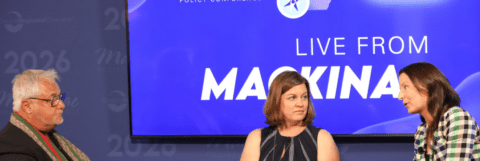
In a conversation with the Detroit News’ Chad Livengood, state Sen. John Damoose (R-Harbor Springs) emphasized the enduring importance of Michigan’s automotive industry as a cornerstone of both the state and national economy. Drawing on his family’s deep ties to Ford and Chrysler, he described the industry as central to innovation, job creation, and economic growth across Michigan and beyond.

He warned that increasing competition from other states, coupled with inconsistent policies, puts Michigan at risk of losing future investment. He noted that an industry insider once told him, “One minute you love us, the next minute you hate us. One minute you’re cracking down on us regulation-wise, next minute you want us back.”

Deputy Wayne County Executive Assad Turfe and Rep. Alabas Farhat (D-Dearborn) spoke with the Detroit News’ Chad Livengood, and together they discussed the upcoming ballot measure that will present a countywide millage to Wayne County residents to create a more unified and functional system across all 43 communities.

Turfe emphasized the structural significance of the proposal, noting that it represents the first opportunity for voters to support a fully connected, countywide transit plan to eliminate longstanding gaps caused by opt-outs and fragmentation. “It’s the opportunity for the first time in Wayne County’s history to be able to have a countywide transit millage to get all 43 communities included into our transit plan,” he said.

Farhat highlighted the legislative effort behind enabling the ballot initiative, describing broad demand from both residents and the business community for a system that better connects people to jobs, education, and services. He pointed to inefficiencies in the current system as a key motivator for reform, saying, “It’s a ridiculous system. It’s like a Swiss cheese system we had that made no sense… we want an all-in system where all the communities are a part of a transit system that makes sense.”

Speaking to Detroit News’ Chad Livengood, U.S. Rep. Kristen McDonald Rivet (D-MI 8) focused on the growing financial strain facing working families and the need for policies that put more money back in people’s pockets. Pointing to the high cost of raising young children, she described affordability as one of the most urgent challenges families are navigating. Highlighting her proposed Working Parents Tax Credit, she also emphasized that affordability solutions do not have to be partisan, arguing that meaningful progress is possible when lawmakers focus on solving real problems rather than political performance.

“I’m just going to challenge this notion that Democrats and Republicans never talk to each other,” she said. “ …We actually can get things done as a country when we have serious people who really understand how hard it is for most of the families right now, not just in Michigan, but across the country.”

State Reps. Ann Bollin (R-Brighton) and Joe Tate (D-Detroit) also chatted with Vaughn about their parties’ ideas for the state budget and their bipartisan efforts to meet the July 1 budget deadline. Both parties were confident that bipartisan negotiations would play out over the next month and produce the final product by the budget deadline.

“We’re seeing a lot of discourse around the budget, as it should be. With the legislator, we have 148 members, and then you have the governor, but we are on the right track,” Tate said. “There are a lot of conversations that are going on, but we are really excited about what we can do and looking forward to working on this final product.”

“I think there is a lot more common ground in the Capitol and in the Chambers than people realize,” Bollin said. “We know we want to make life more affordable… we want our kids to be able to read, we’re 44th in the country… these are things where the soundbites are bigger than the actual bitterness.”


Closing “Live From Mackinac” for the day, Brian Calley of the Small Business Association of Michigan and Chandra Madafferi of the Michigan Education Association finished up the day’s conversations with Jerome Vaughn, discussing the upcoming November ballot question number one, the possibility of a Constitutional Convention for Michigan.  

“This is a question that is asked every 16 years automatically of voters, do you want to scrap the old constitution and start fresh?… It is a dramatic and expansive change to literally every aspect of the legal landscape in our state. So this isn’t just any old ballot proposal,” Calley said. “You already see what this system produces today. That’s the system that would be charged with a new constitution.” 

“[The Constitution is] a playbook, so it’s better to tweak something, and that’s what we do by passing laws than just to throw the whole thing out … not to simplify it too much, but it would just be complete chaos and mayhem. Even in a good time where people can work together and collaborate and discuss and agree on issues, that would be one thing, but we are not in that time at all in our society,” Madafferi said. “I don’t want to use the word ‘war’ literally, but people would not be able to agree… everything would almost stop in time.”