Detroit Regional Chamber > Mackinac Policy Conference > Opening Session: Michigan… Our House is on Fire 

Opening Session: Michigan… Our House is on Fire 

May 26, 2026 Anjelica Miller headshot

Anjelica Miller | Manager, Communications, Detroit Regional Chamber

Top Takeaways

  • Riney said Michigan’s trajectory across core measures should make attendees “a little uncomfortable,” arguing that leaders “don’t ever solve a problem by failing to recognize that you have one.” 
  • Both speakers stressed that Michigan’s challenges are not partisan. As Riney put it, “This is not a Democrat or Republican issue. This is a Michigan issue.” 
  • The opening session previewed the broader agenda, pairing the diagnosis that “Michigan, our house is on fire” with the guiding question and provocative acronym for the days ahead: “What’s the Fix?” 

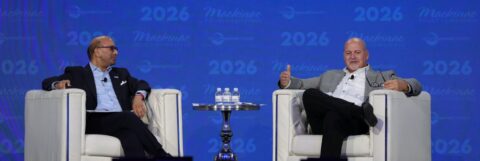
The 2026 Mackinac Policy Conference opened with a clear warning from Detroit Regional Chamber President and Chief Executive Officer Sandy K. Baruah and Conference Chair Bob Riney: Michigan cannot afford to ignore its long-term decline in several key measures of economic strength and competitiveness. 

Riney told attendees to “prepare to get a little uncomfortable,” arguing that “you don’t ever solve a problem by failing to recognize that you have one.”  

At the same time, both speakers stressed that Michigan’s challenges are solvable and that the state still has the assets, institutions, and people needed to reverse course if leaders are willing to work toward sustained, bipartisan solutions. 

View the full video below.

Related | Get to Know ‘Unusual Suspects’ 

The Data Shows Michigan Is Losing Ground

Riney’s central argument was that Michigan’s warning signs are longstanding and systemic, not recent or isolated. Using a series of comparative rankings dating back to 2000, he pointed to sharp declines in per capita income, unemployment ranking, labor force participation, population growth, GDP growth, job growth, educational attainment, and student support indicators.  

He said the numbers make clear that “we have a ‘we’ problem” and argued that the trends cut across administrations and partisan control, making them a statewide challenge rather than a Democratic or Republican one.  

Baruah reinforced that point by highlighting Chamber polling showing many voters believe Michigan is performing near the middle of the pack on these measures when, in reality, the state ranks near the bottom on several of them.  

“It’s hard to solve a problem if you don’t think you have one,” Baruah said, warning that meaningful reform will be harder to achieve if voters do not yet recognize the scale of the challenge. 

Related | Michiganders Seek Compromise, Do Not Recognize How Badly Michigan Ranks on Key Economic Indicators Since 2000 

Michigan is a Home Worth Fighting For

Even as they detailed troubling trends, both speakers made the case that Michigan remains uniquely positioned to compete if it can align around a durable strategy.  

Riney described Michigan as “a state worth fighting for,” and said, “Let’s make no mistake, we’re in a fight,” pointing to the state’s natural assets, authentic communities, quality of life, affordability, high homeownership rate, climate resilience, and water resources. He also highlighted the state’s innovation foundation, including four R1 universities, strong business-led research and development activity, startup momentum, and growing venture capital investment.  

Baruah added that Michigan remains “such a great place to live,” citing the state’s natural beauty and momentum in communities across Michigan. The message was that Michigan is not lacking a foundation; rather, it is failing to fully leverage its strengths through consistent execution and long-term focus. 

Common Ground and Long-Term Solutions

The session also served as a roadmap for the rest of the Conference. Riney said this year’s program was intentionally designed to create more space for meaningful conversations, cross-ideological engagement, and networking across generations of leaders. Baruah noted the agenda was curated to expose attendees to speakers with differing viewpoints who nevertheless model collaboration and civility.  

Together, they introduced the Conference’s parallel framing of “Michigan, our house is on fire” and “What’s the Fix?” — a call not just to diagnose Michigan’s decline, but to identify policy approaches that can endure over time. Further explaining the concept, Riney argued that “common ground does not mean all thinking alike,” but rather “how we reach collaboration” and “a point of action versus paralysis.”  

Both implored how Michigan must move away from short-term policy reversals and toward a more stable, predictable strategy that supports growth, attracts investment, and creates confidence for the future. Their closing message was that Michigan’s challenges are serious, but not irreversible, because “this is a state worth fighting for” and “a state worth winning.” 

Learn more about Michigan, our house on fire at houseonfiremi.com

This session was sponsored by Business Leaders For Michigan.