- All three candidates want to end the U.S. Senate filibuster.
- Rep. Haley Stevens and Sen. Mallory McMorrow emphasized bipartisanship, which Abdul El-Sayed critiqued as elites shutting average people out.
U.S. Senate Democrat Candidates Debate at the 2026 Mackinac Policy Conference
May 28, 2026
Steve Friess |
Top Takeaways
Speakers


Senate Race Tightens Ahead of August Primary
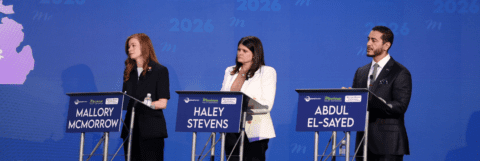
The three leading Democratic candidates for Michigan’s U.S. Senate seat appeared at the Detroit Regional Chamber’s 2026 Mackinac Policy Conference for a mostly genteel debate in which they agreed the filibuster must go. Still, they diverged on the value of bipartisanship and AIPAC’s influence on the campaign.
Polls have suggested a tight race in the Aug. 4 faceoff between former Detroit Health Department Director Abdul El-Sayed, State Sen. Mallory McMorrow (D-Royal Oak), and U.S. Rep. Haley Stevens (D-MI 11). The Chamber’s recent survey found Stevens and El-Sayed in a statistical tie, but an Emerson College poll in April found El-Sayed in a dead heat with McMorrow.
The winner is expected to face former Republican congressman Mike Rogers in November 2026 to fill the seat being vacated by retiring Democratic Sen. Gary Peters.
The Filibuster Must Go
The most significant overlap occurred when asked about the filibuster, which requires 60 votes in the Senate to move to a final vote on most legislation.
“It keeps us from being able to move forward with legislation that we absolutely need, so I believe we have to abolish the filibuster,” El-Sayed said. “We have to expose the senators to democracy again so that they have to answer to their voting public about why they took a particular vote, because I know it would change the way that they behave.”
Both McMorrow and Stevens agreed, although Stevens’ answer led to some confusion after she first declared that “the filibuster must go” and then also said Democrats should have been able to use it to stop last year’s tax-cutting “One Big Beautiful Bill” Act.
Moderator Stephen Henderson of Detroit PBS and BridgeDetroit pressed her on that contradiction — the bill was exempt from the filibuster because of what’s known as reconciliation — to which she replied: “Democrats should have been able to vote down the tax bill. Stephen, that’s why I said we need to get rid of the filibuster. That tax bill should not have happened.”
Bipartisanship vs. Populism
The trio were asked how they would move legislation through a narrowly divided Senate, prompting McMorrow and Stevens to cite examples of bipartisan legislation they helped pass.
McMorrow pointed to a 10-year state economic plan co-sponsored with Republican state Sen. John Damoose (R-Harbor Springs) and passed in December that “expanded registered apprenticeships in Michigan into advanced manufacturing, into health care, into tech, into agriculture to give people the ability to build something entirely new.”
In Stevens’ case, she highlighted her role in passing the CHIPS and Science Act, which allotted $280 billion in subsidies and tax credits to support domestic research and manufacturing of semiconductor chips.
“That created Michigan jobs, lessening our dependence on China and creating growth right here in Michigan,” she said.
El-Sayed, on the other hand, pivoted to question the virtue of deals among senators and interest groups.
“The conversation that needs to be had isn’t just the one that we have with the 99 other senators or the folks in Congress or even a president,” he said. “It’s the conversation we have with the 350 million people who elect all of us, and I think that’s where we have an opportunity to actually find like-minded opportunities with Republicans who understand that their people, too, are getting picked apart.”
This session was built in coordination with the Michigan Debate Commission and sponsored by Consumers Energy.