Detroit Regional Chamber > Advocacy > A Conversation With Mike Duggan

A Conversation With Mike Duggan

May 26, 2026 Steve Friess headshot

Steve Friess | Freelance Writer

Top Takeaways

  • A once-promising independent bid for governor was derailed by fundraising challenges, $5-a-gallon gas, and a Democratic polling surge. 
  • Because of Michigan’s “purple state syndrome,” the state is “watching Ohio and Indiana eat our lunch right now” on jobs. 
  • Duggan urges leading candidates of both parties to offer a “strategy to change the direction of the state,” not a “strategy that helps you win.”

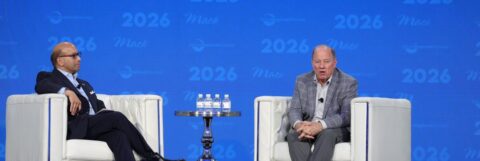
Days after stunning Michigan’s political crowd by abruptly ending his independent quest for the Michigan governorship, former Detroit Mayor Mike Duggan closed the first day of the 2026 Mackinac Policy Conference with a plea to both parties to find the common ground – which voters consistently tell pollsters they want. 

Watch the full video below.

A Dramatic Polling Shift

Duggan said a major shift in the national mood, sparked by President Donald Trump’s decision to invade Iran and the resulting massive surge in gas prices, led him to slip 11 points in this month’s Chamber-sponsored poll from his February 2026 peak. 

“Was I going to come to this Conference and tell you all double down on what you’re doing [and say] ‘Don’t worry, I got a clear path to win,’ when I didn’t feel that?” Duggan asked. “I just couldn’t do it, and so I’m sorry for the people here who are disappointed, but I would have disappointed you far more if I had gone for another five months knowing there’s not a path and continuing to come back to you and say we’ve got to fund it.” 

After the Iran war began, the tenor of his campaign appearances, particularly with Democrat-leaning audiences, changed, he said. Interest and curiosity, he said, morphed into fear that voting for him would help a Republican win. Polling reflected that; in February, 60% of Democrats and Republicans were open to voting for him. By May, 65% of Democrats said they “were afraid to vote for me because they were afraid of tipping the elections.” 

Duggan had been endorsed by the Chamber Political Action Committee (PAC) as well as scores of union groups and more than 200 current or former elected officials across the state of both parties. But it wasn’t enough. 

“What has happened in this country, at least in the Democratic attitudes, is that there is a depth of anger that has displaced everything else,” he said. “We phoned pollsters all over the country, and they said they’re seeing the same thing everywhere. Democrats are surging at all levels of office everywhere in the country. This was not some blip.” 

Fearing the National Fundraising Tsunami

Duggan’s polling doldrums came as he began to realize, as he put it, “There is no national fundraising base that says, ‘I want an independent governor in Michigan.’” 

In 2025, Duggan outraised all other gubernatorial candidates, with 94% coming from within the state. Yet as the calendar flipped, he realized tens of millions were coming from the national parties and other groups that he could never match. Part of that is because Michigan is one of the few genuine swing states for presidential elections. 

“I’m not telling you that the California Democrats are that concerned about whether our eight-year-olds read, but they are very concerned about the ’28 presidential [election],” he told Chamber President and Chief Executive Officer Sandy K. Baruah. “I looked at this and I said, ‘Okay, the path has narrowed significantly. I’ve got to go back to my Michigan donors and say no national money is coming. … When you spend a year-and-a-half of your life, day and night, working hard for something, … it was a really hard thing” to accept. 

“Purple State Syndrome” Harms Michigan

Often, Duggan said, he’s asked why he didn’t run as a Democrat.  

“Never, for one second, did I think about that in my life,” he insisted. 

His experience as Detroit mayor and his analysis of Michigan’s political history in this century, he explained, showed him that it was partisanship that is holding the state back from being competitive with Rust Belt neighbors like Ohio and Indiana. 

“You think about the three last governors of the state, Jennifer Granholm, Rick Snyder, Gretchen Whitmer, three of the smartest people I have ever met, dedicated public servants who wanted nothing more than to help this state, and the sum total of their 24 years is … [going from] 16th to 44th in third-grade reading, 19th to 40th in per-capita income, 49th in population growth,” he said. “Is the problem that they weren’t good enough, or is there a problem with the system? And it really is what I call it: the purple state syndrome.” 

Repeated swings in who’s in power over the past two decades leave businesses and potential residents uncertain about Michigan’s future. 

“When it comes to jobs, we’re watching Ohio and Indiana eat our lunch right now,” he said. “We know what the strategies are, but every two years we change direction. … I ran as an independent because I thought it was the only way to change this 24-year trajectory.” 

Related | From the Detroiter Magazine: The Ohio Way 

He still believes something fundamental needs to change and called on the Mackinac audience to make it happen. “It’s going to probably take people from outside of government, kind of like the thing you’re doing here today, to get the two parties to work together better than they are.”  

Related | Duggan: Find Issues People Agree On, and Fix Those First